



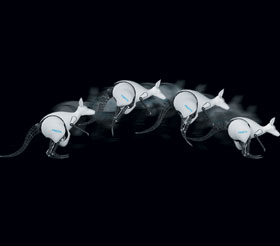
Festo has recreated the jumping behaviour of the kangaroo. Like its natural model, the BionicKangaroo can recover the energy generated when jumping, store it and efficiently use it for the next jump. This requires sophisticated pneumatic and electrical drive technology and jump kinematics. The BionicKangaroo features pneumatic actuators that provide the jumping power and at the same time act as shock absorbers on landing. The necessary compressed air is supplied either from a small compressor or from a high pressure storage device on board. Electric motors are used for maintaining balance and controlling the kangaroo’s position with high accuracy. All electric components rely on energy from rechargeable lithium polymer batteries.
When standing, the kangaroo touches the floor with both its feet and tail giving it a stable three points of contact; it also provides the necessary balance when jumping. An electric servomotor specifically controls its angle of attack and ensures the corresponding compensatory movement. The legs are also controlled by two electric servomotors, which sit between the hip and thigh, so that these can be moved forward and backwards. All the control signals are generated by the compact control system.
A Festo DSNUP 20 pneumatic lightweight cylinder is attached along each lower leg, which actuates the leg. The knee and ankle joint are connected via a positive kinematic device, resulting in an interlinked movement sequence. The function of the natural Achilles tendon is adopted by an elastic spring element made of rubber. It is fastened at the back of the foot and parallel to the pneumatic cylinder on the knee joint. The artificial tendon cushions the jump, simultaneously absorbs the kinetic energy and releases it for the next jump.
The condition monitoring as well as the precise control technology ensures the required stability when jumping and landing. The energy status of the kangaroo, the manipulated variables and angle of attack are constantly monitored and evaluated. At the same time, the control system processes multiple sensor values. They go into complex control algorithms, which result in the manipulated variables for triggering the cylinders and motors.
The rubber tendon cushions the jump and absorbs the kinetic energy upon landing. Before the first jump, it is pneumatically tensioned and the kangaroo starts tilting forward. As soon as a defined angle is reached, the pneumatic cylinders are activated, the energy from the tendon is released and the kangaroo takes off, thrusting its legs forwards and lifting its tail. The control system makes sure the legs cover as much ground as possible and the tail movement compensates for the torque created at the hip area, so the top of the body stays almost horizontal.
On hitting the ground, the tendon is tensioned again, thus converting the kinetic energy of the previous jump to potential energy that can be stored in the system and used for the next jump. By channelling the energy directly into the next jump and aiding each hop in exactly the right moment by switching the valves, the BionicKangaroo is able to take several jumps in a row without expanding much energy.
Festo developed two different concepts for the mobile energy supply – one with an integrated compressor and one with a mobile high-pressure storage device. Both supply the compressed air necessary when jumping, which is dosed out exactly by two Festo MHE2 solenoid valves. Lithium polymer rechargeable batteries act as electrical energy storage devices. They supply both the valves and the electric drives, as well as the integrated Festo CECC control system, with the necessary power.
To top it off, the BionicKangaroo can be controlled by gestures using a special armband which detects the operator’s movements using a position sensor. The armband sends these signals via Bluetooth to the compact control system, upon which it starts to interact with the operator, allowing it to be beckoned from across the room.
The purpose is to learn from nature and impart this knowledge into the field of robotics and automation. This remarkable demonstration of integrated automation shows the efficiency of combining different automation components and demonstrates the concept of using mobile pneumatics to recover, store and efficiently reuse potential energy. By demonstrating the principle of permanent diagnostics, Festo hopes to contribute to operational safety and process stability that could eventually shape the future of industrial environments.
For more information contact Tracey Swart, Festo, 08600 FESTO, [email protected], www.festo.com
| Email: | [email protected] |
| www: | www.festo.co.za |
| Articles: | More information and articles about Festo South Africa |






© Technews Publishing (Pty) Ltd | All Rights Reserved
 printer friendly version