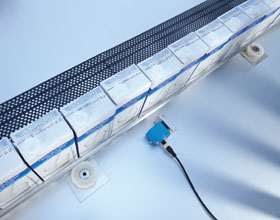
The new DeltaPac from SICK Automation allows reliable detection of objects within continuous flow production and packaging lines. Generally, packages have to be separated in order to count or detect them by means of photoelectric sensors. DeltaPac renders such separation – frequently implemented using elaborate mechanical systems installed in the conveyor section – a thing of the past.
What makes this possible is the patented Delta-S-Technology from SICK. Four PinPoint emitters and two receivers are combined with SICK’s SIRIC and distance measurement technology. The functional principle of DeltaPac relies on the edge contours of objects. In a gapless transition from one object to the next, the edges present a change in the reflective behaviour of the package surface, which is used to generate the output switching signals. Object contours with radii of up to 20 mm can be detected reliably and the high-precision evaluation characteristic of DeltaPac ensures detection of even the smallest changes in angle. In this way, users can dependably detect up to 200 000 packages per hour at speeds reaching 3 m/s.
Implications for the construction of packaging machines
DeltaPac detects objects travelling in push-push mode. This affords new options when designing packaging machines as it is possible to do without both the machine elements traditionally used for buffering and the mechanical systems that were responsible for separation. This saves cost and improves the spatial balance of the machine, resulting in a smoother product flow since packages no longer topple over and collisions are avoided. Machine downtimes, incorrect picks during package grouping and quality loss due to crashes are prevented. Added benefits are the positive effects on the packaging machine’s utilisation of time, energy and availability.
Whether the requirement be fast commissioning without adjustment or well-directed process optimisation by means of individual parameterisation, SICK has translated the demands by manufacturers of packaging machines into pre-configured devices. Installing, connecting and detecting are easy and the user does not have to deal with extensive operating instructions. The sensor variant featuring IO-Link makes it possible to parameterise according to operating conditions, e.g. for different packages.
Market opportunity for sensors in humanoid robots
Sensors & Transducers
A new IDTechEx report forecasts the market for sensors in humanoid robots will exceed $6,59 billion by 2037, driven by perception sensors, force/torque sensors, encoders and inertial measurement units across a growing range of commercial robot platforms.
Read more...The wireless route to safer, more efficient mining operations Emerson Automation Solutions
Editor's Choice Sensors & Transducers
Modern wireless level measurement technologies are helping mining operations improve process control, increase safety and reduce installation costs. Emerson’s Rosemount 3408 wireless non-contacting radar level transmitter uses 80 GHz frequency-modulated continuous wave radar with HART communication to reach remote assets where cabling is impractical.
Read more...Telco sensors for harsh environments
Sensors & Transducers
Telco sensors are designed to operate where moisture, particulate contamination and surface fouling would disable conventional sensors, with a range including an adjustable five-metre infrared proximity sensor for harsh industrial environments.
Read more...The data-driven path to sustainable manufacturing ifm - South Africa
Editor's Choice Sensors & Transducers
Smart automation is closing the gap between operational efficiency and environmental responsibility, and the data to do it is already inside the plant. With ifm’s sensing and digitalisation technologies, manufacturers can turn machine intelligence into measurable sustainability gains.
Read more...Expanding visibility in mining operations Emerson Automation Solutions
Editor's Choice Sensors & Transducers
Advances in wireless communications, condition monitoring and sensing technologies are helping mining operators extend measurement into previously under-monitored areas, improving equipment reliability, process performance and water stewardship.
Read more...Fiber-optic amplifiers for precise object detection ifm - South Africa
Sensors & Transducers
The OCF fibre-optic amplifier detects even the smallest or most transparent objects in confined spaces, making proven fibre-optic technology easier and more user-friendly than before.
Read more...Distance sensor for confined spaces ifm - South Africa
Sensors & Transducers
The O6D100 from ifm has been designed as a powerful all-rounder for typical applications in object detection, distance measurement and positioning.
Read more...Optimise sludge treatment and reduce operational costs Endress+Hauser South Africa
Sensors & Transducers
Endress+Hauser’s inline measuring devices, the Proline Teqwave MW 300 and the Proline Teqwave MW 500, determine the total solids content of wastewater directly through microwave transmission.
While every effort has been made to ensure the accuracy of the information contained herein, the publisher and its agents cannot be held responsible for any errors contained, or any loss incurred as a result. Articles published do not necessarily reflect the views of the publishers. The editor reserves the right to alter or cut copy. Articles submitted are deemed to have been cleared for publication. Advertisements and company contact details are published as provided by the advertiser. Technews Publishing (Pty) Ltd cannot be held responsible for the accuracy or veracity of supplied material.










 printer friendly version