National Instruments redefines the SMU
May 2014
PLCs, DCSs & Controllers
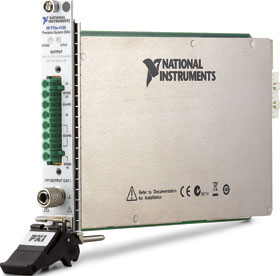
National Instruments has announced the NI PXIe-4139 system source measure unit (SMU), a high-performance addition to the company’s SMU portfolio. This SMU can reduce overall cost of test and accelerate time to market for test engineers in a broad range of industries, from semiconductor to automotive and consumer electronics.
“With the NI PXIe-4139, engineers and scientists get broad IV boundaries, including extended range pulsing capability up to 500 W and sensitivity down to 100 fA, to test a wide range of devices with a single instrument,” says Luke Schreier, senior group manager of test systems for National Instruments. “The compact size of the NI PXIe-4139 is also critical. It can reduce system footprint significantly compared with legacy box instrument SMUs.”
The NI PXIe-4139 features NI SourceAdapt technology to help engineers produce optimal SMU response to any load by customising the SMU control loop. This protects devices under test and improves system stability. Additionally, the NI PXIe-4139 system SMU can take measurements at 1,8 MS/s, which is 100 times faster than traditional SMUs. This helps reduce test time and offers engineers the ability to capture transient device behaviour without an external scope.
“A redefined approach to instrumentation is necessary if you want to keep pace with the increasing complexity of modern electronics,” adds Schreier. “SourceAdapt technology, coupled with the inherent benefits of PXI modular instrumentation and NI LabVIEW system design software, gives engineers a competitive edge in reducing test times and protecting their devices under test.”
Key features:
* 100 fA current measurement sensitivity: precisely characterise high-performance semiconductor devices.
* 1,8 MS/s sampling rate: capture transient device characteristics without an external oscilloscope.
* Up to 17 SMU channels in 4U rack space: minimise test system footprint for high-channel-count systems.
* SourceAdapt technology: reduce transient times to protect the device under test even on highly inductive or capacitive loads.
Further reading:
Network-capable remote relay system with flexible channel assignment
Phoenix Contact
PLCs, DCSs & Controllers
Phoenix Contact has launched a modular PLC-Interface Ethernet Gateway remote relay system with up to 56 configurable I/O channels, multi-protocol support including Profinet Class C and S2 redundancy, and compatibility with established controller software for straightforward network integration.
Read more...
Seven checks before replacing an obsolete industrial control component
PLCs, DCSs & Controllers
An obsolete control component rarely fails in isolation. Before ordering an exact spare, manufacturer successor or engineered alternative, maintenance and procurement teams should work through seven checks to define the problem properly and avoid a costly mismatch.
Read more...
Loop signature Part 2-6
PLCs, DCSs & Controllers
This instalment of the Loop Signature series introduces frequency plot theory as a foundation for understanding process dynamics, explaining Bode plots, dynamic gain, phase lag and their relationship to control loop tuning.
Read more...
The rise of software-defined brownfield automation
Schneider Electric South Africa
PLCs, DCSs & Controllers
Schneider Electric’s EcoStruxure Automation Expert is enabling brownfield operators to modernise incrementally, decoupling control logic from hardware to bridge legacy equipment and future-ready operations without disrupting production.
Read more...
Upgrading alarm systems for critical industries
Omniflex Remote Monitoring Specialists
PLCs, DCSs & Controllers
Omniflex’s OMNI16R alarm annunciator platform provides a direct replacement for legacy CSA systems such as MPAS 90 and SA9100, enabling operators in oil and gas, nuclear and power generation to modernise alarm infrastructure without sacrificing the clarity required for safe operations.
Read more...
How DCS can step off the hardware obsolescence treadmill
Schneider Electric South Africa
PLCs, DCSs & Controllers
Schneider Electric argues that virtualising DCS environments breaks the cycle of hardware obsolescence, giving plant operators a smarter path to lifecycle modernisation without production disruption.
Read more...
Loop signature Part 2-6
PLCs, DCSs & Controllers
The Loop Signature series turns to frequency plot theory, explaining Bode open-loop plots and how dynamic gain, phase lag and crossover frequency can be extracted from test data to inform more accurate control loop tuning.
Read more...
PC-based control in surgery
Beckhoff Automation
Editor's Choice PLCs, DCSs & Controllers
Researchers at the University of Basel are using Beckhoff PC-based control technology to develop a miniature laser robot for minimally invasive bone surgery.
Read more...
IIoT controller for the field and control cabinet
ifm - South Africa
PLCs, DCSs & Controllers
The IIoT controller from ifm is a powerful, communicative and flexible PLC solution in machine and plant digitalisation.
Read more...
How the DCS can step off the hardware obsolescence treadmill
Schneider Electric South Africa
PLCs, DCSs & Controllers
Ageing servers and unsupported operating systems are quietly eroding the stability of process plants that rely on distributed control systems. Kobus Vermeulen of Schneider Electric explains how virtualising the DCS environment can break the hardware obsolescence cycle without disrupting operations.
Read more...










 printer friendly version