



The old adage that ‘time is money’ is a fact of life for many plant operators who must deal with the possibility of equipment breakdowns and loss of productivity as part of their daily routine. Particularly in the current economy, such occurrences go directly to a company’s bottom line. Thus, the need for a reliable and effective condition monitoring programme is a key consideration in the quest to maximise productivity.
Choosing the right maintenance programme and the right equipment is crucial to minimising the costs of equipment maintenance and achieving optimum utilisation of maintenance and operations personnel. Plant engineers and maintenance personnel need a diagnostic tool that quickly and reliably measures and stores readings that detect changes in a machine’s health and performance. Ultimately this will lead to increased plant uptime and enhance profitability.
The old way
Traditional single or dual channel data collectors offer what can be a slow, cumbersome process for maintenance personnel who may be hard pressed to perform their assigned monitoring tasks as quickly as possible.
For example, to measure vibrations on a motor pump, standard practice requires placement of the single vibration sensor on the non-drive end of the motor pump in the horizontal plane. When the data collector provides its results, they are compared against a pre-defined alarm limit and stored in the data collector. Next, the vibration sensor is repositioned to the vertical plane, where the process of measuring, comparing and storing is repeated. To complete the motor pump assessment, the sensor will need to be repositioned multiple times, once for each measurement point required along the machine train. For a large plant with several machines to survey, such a single channel practice can become time consuming.
A better way
Using a multi-channel data collector/analyser with a tri-axial sensor can speed up the process significantly. A tri-axial sensor consists of three independent sensors placed at 90 degrees to each other and wired on a multi-pin connector. Using a tri-axial sensor eliminates the need to relocate the sensors in between the horizontal, vertical and axial locations, ultimately consolidating them into one location. As a result, three planes can be recorded simultaneously in the same amount of time that it takes to record one reading with a single-channel data collector.
Another key advantage that a multi-channel data collector offers is the ability to observe the operating deflection shape (ODS) of a machine. An operating deflection shape is an animated picture that illustrates the machine’s movement, where it is moving the most, and the area in which the deflection modes (flexible or rigid body) are present. Due to its illustrative characteristics, ODS analysis also can provide quick insight into the movements and the associated problems of the machinery structure as a function of frequency. As such, it can be a very powerful analytical tool.
The SKF solution
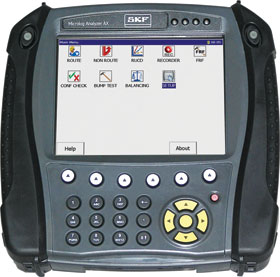
Modern data analysers, such as the SKF Microlog Analyser AX, feature special analysis software programs to perform ODS analysis according to a structured procedure. In addition to industry-proven SKF Acceleration Enveloping (gE) technology, the Microlog AX provides the capabilities of 4-channel non-route/2-channel or simultaneous triaxial route analysis and 2-channel balancing. Users can select from a range of application modules, creating a custom device that suits their specific requirements.
Modules can be added as a user’s needs evolve, thereby increasing the value of the hardware investment by upgrading capabilities without the need to buy a new instrument. Application modules include balancing, frequency response, run up/coast down and check to conformance. This range of application modules allows users to perform advanced tasks, including digital recording, modal analysis, transient phenomena analysis and quality inspections – all with the same device.
Whether a facility is just beginning an analysis programme, or has senior analysts with a wealth of experience, the SKF Microlog AX offers functionality and flexibility that fits.
New users can benefit from the speed, accuracy and consistency of tri-axial and multi-channel measurement capabilities, while advanced users can get some of the highest quality analysis capabilities available all in one full-featured instrument.
When machinery goes down, productivity and profitability goes with it. Three and four channel data collectors increase the speed and efficiency of data collection and measurement to detect machine health and performance in a way that is easy to use and read. As more and more operations utilise this innovative tool, their ability to optimise both personnel time and maintenance costs grows – the result is increased savings and better profitability.
For more information contact Samantha Joubert, SKF South Africa, +27 (0)11 821 3500, [email protected], www.skf.co.za
| Tel: | +27 11 821 3500 |
| Email: | [email protected] |
| www: | www.skf.co.za |
| Articles: | More information and articles about SKF South Africa |






© Technews Publishing (Pty) Ltd | All Rights Reserved
 printer friendly version