



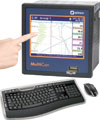
In the previous two articles (SAI&C May & June) we presented the device design and options for presentation of results and operation using the touch panel. To have a full picture of the potential of MultiCon, in (the final) Part 3 we will focus on processing measurement data, control functions and possibilities of cooperation in network systems.
The distinguishing feature of MultiCon is its capability of simultaneous implementation of tasks related to measurements, processing, control and recording of data. To make this possible, the designers have used the concept of ‘logical channels’ which are virtual bridges between physical I/O and control and visualisation processes. An expanded configuration menu of logical channels allows for precise configuration.
In the MultiCon devices, it is the user who decides how to use the available logical channels. The parameter which allows selection of the channel function is the ‘operation mode’. It can be set so that the logical channel:
* Represents the data from physical inputs and outputs.
* Processes the data from other logical channels using the mathematical and logical functions.
* Generates constant values (set points) or sequence diagrams (profiles); works in the PID controller mode; constitutes a virtual function key.
Relationships between channels (including mathematical operations on the values) can be set directly in the device and it is not necessary to know any programming language. As the essence of any data processing is mathematical operations in the device, many standard functions have been provided to build complex algorithms.
In addition to the basic mathematical functions, such as addition, subtraction, multiplication and division, the device allows, amongst others, to use trigonometric functions, calculate the mean or maximum or minimum value from any number of channels, as well as logical functions or comparison and selection. The source of data in mathematical functions can be of other logical channels and constant values set in the menu.
One of the most important functions of MultiCon is a controlled configuration menu of built-in outputs (e.g. relays) which allows use of them directly as so-called two-position controllers.
Free combination between inputs and outputs allows users to create multi-channel controllers operating independently. In addition, the concept of logical channels provides an opportunity of making many outputs (including outputs of different types) dependent on a single input channel, while introduction of mathematical operations significantly expands the control options. In addition to ordinary On/Off control using binary signals, MultiCon allows PID control using built-in and external analogue outputs or SSR outputs in the PWW mode.
Each of 60 logical channels can be set in the PD, PI, PID controller modes with an independent set-point, input and output. The user can choose from eight sets of PID control parameters, each of which can be assigned to many logical channels operating in the controller mode. This is an ideal solution when many similar processes need to be controlled; the MultiCon can work then as a unique multi-channel PID controller.
A necessary supplement to the control functions of the device is the possibility of automatic change of the set value – timers/profiles – which allow for generating signals of a user defined waveform and duration. What is important is the MultiCon allows users to define profiles up to 100 sections long; the duration of each of them can be different. Additionally, looping can be introduced and the trigger moment and method (e.g. by a state of another channel or a RTC clock) defined. Thanks to such flexibility the selected process can be launched cyclically, e.g. on a set day of the month at a set time, with additional conditions allowable.
An advantage of MultiCon is that it can cooperate with other devices and systems. The basic configuration includes a single RS-485 port with Modbus RTU interface. It is however sufficient to add an ACM module to increase the application potential many times. This module is equipped with isolated RS-485 and RS-485/232 ports, an Ethernet interface and an additional USB port. Each of the serial ports is a separate interface with Modbus RTU protocol and can operate independently of the others, both in the Master and Slave modes.
Expanded communication possibilities are particularly useful when it is necessary to control a very high number of physical execution units or collect data from many distant sources.
Via Modbus RTU, MultiCon can use external inputs/outputs (i.e. inputs and outputs for other devices) just as it uses the built-in modules – it can read data and control the outputs of other devices present in the network. In addition, in the Slave mode it is possible to write data in individual MultiCon logical channels (up to three at a time). Combining these options, MultiCon can become a programmable network hub.
The Ethernet interface was described in more detail in Part 2, so let us just turn to implementation of the Modbus TCP protocol which allows connection to the device with other systems via the Internet. Using the World Wide Web, users can also control the device and download data on-line using dedicated software. All tools are available free of charge on the manufacturer’s website.
Summary
This series of three articles was designed to introduce some of the great potential of these devices, quite incomparable to their small size – users are encouraged to explore the functionality.
The device is constantly being developed, measurement options are expanded, new software improvements are made and new functionality is introduced at the request of users. A specific modification can also be ordered by a customer. Functions like these are not provided on any competing devices in the market.
For more information contact Rodney Topham, RET Automation, +27 (0)11 453 2468, [email protected], www.retautomation.com
| Tel: | +27 11 453 2468 |
| Email: | [email protected] |
| www: | www.turckbanner.co.za |
| Articles: | More information and articles about Turck Banner Southern Africa |






© Technews Publishing (Pty) Ltd | All Rights Reserved
 printer friendly version