



Nearly 60% of operators are expected to adopt liquid cooling within five years as AI-driven economics reshape infrastructure investment priorities. For the modern data centre operator, the shift to liquid cooling represents a considerable change in direction that will define the competitive landscape of infrastructure for the next decade.
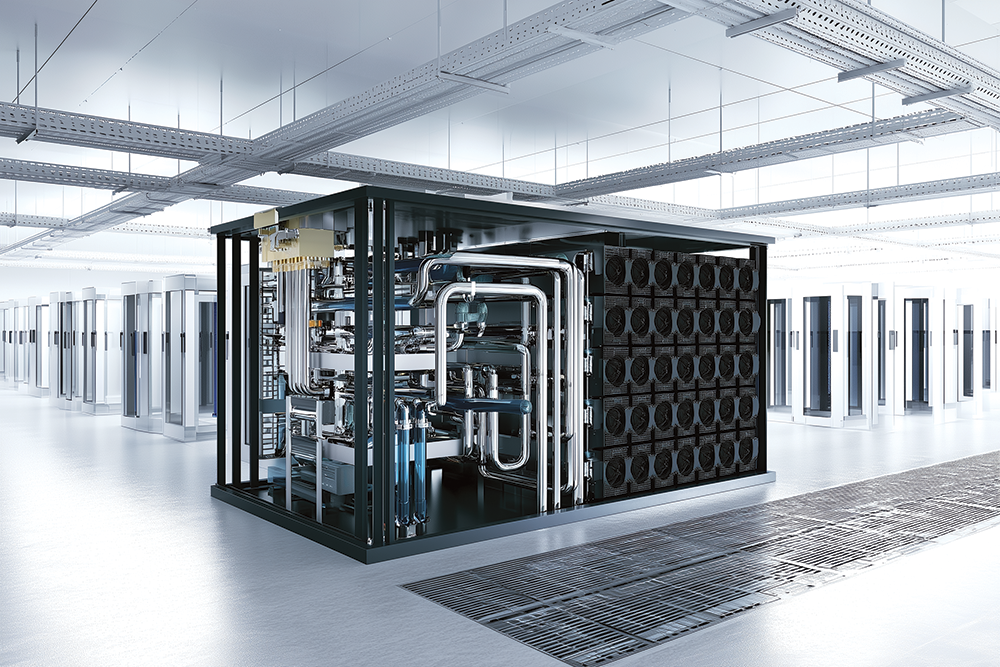
As AI data centre cooling demands accelerate, operators are evaluating liquid cooling strategies as the primary solution for high-density environments. For chief technology officers and infrastructure leaders, success in the AI era depends on understanding the full financial picture of liquid cooling, starting with upfront capital investment and planning strategically for long-term operational and performance benefits.
The chiller paradox
The first critical cooling element to consider is a facility’s heat rejection system. Liquid cooling for AI workloads enables higher rack densities by removing heat more efficiently than traditional air-based systems. Water holds 3 000 times more heat by volume than air, which means liquid cooling can capture heat at significantly higher temperatures.
This creates a critical design crossroads. Do you use an existing low-temperature chiller plant for a hybrid environment, or invest in a dedicated high-temperature system specifically for liquid-cooled loads? While a shared chiller avoids immediate capital expenditure, it anchors the entire facility to the inefficient, frigid temperatures required by legacy air-cooled equipment. Investing in dedicated high-temperature chillers unlocks significant economiser hours, where the system runs without energy-intensive compressors, turning a capital expense into a driver of operational savings.

The real benefit lies in the technology cooling system fluid temperature. Boosting the TCS by 20°C, from 25°C to 45°C, can reduce energy consumption by 30 to 40%. Running at the absolute limit maximises savings, but removes the thermal safety buffer. In the volatile world of AI workloads, overshooting these temperatures means expensive processors will throttle or shut down, creating a downtime risk that far outweighs energy savings.
Compactin is the capex advantage
While many fear a liquid cooling cost premium, a full lifecycle analysis tells a different story. At standard densities, the cost of liquid cooling components is often fully offset by the elimination of expensive air-cooled chillers and computer room air handlers. At high densities, liquid cooling shifts from cost-neutral to a meaningful financial advantage.
Compaction, concentrating more compute capacity into fewer racks and less floor space lowers costs tied to building construction, lighting, fire suppression, and power distribution while improving overall infrastructure efficiency. Compressing compute power into a 20 kW/rack liquid-cooled footprint yields a 10% total facility capital expenditure saving compared with 10 kW/rack air cooling. At 40 kW/rack, that saving rises to 14%.
Replacing power-hungry server fans with efficient micro-pumps reduces the overall IT load, allowing for an estimated $0,14 per watt saving on uninterruptible power supply and switchgear sizing. In the liquid-cooled data centre, a smaller physical footprint is also a less costly one.
The sustainability dividend and heat reuse
Liquid cooling is a practical solution in a resource-constrained world. These systems can reduce total cooling energy by up to 60% and offer significant benefits in water-stressed regions. Traditional air cooling consumes approximately 43 litres of water per minute for every 1 MW of capacity, while liquid cooling, using warmer water and dry coolers, can achieve strong power usage effectiveness (PUE) ratings without draining local water supplies.
Because liquid cooling allows the use of warmer water temperatures, it can effectively use dry coolers with economisers, generating significant energy savings without water-intensive adiabatic evaporation. Rather than venting excess heat into the atmosphere, facilities can repurpose or sell it for district heating and industrial applications, creating new revenue opportunities while advancing carbon-reduction goals. Market analysts project the global data centre heat-reuse-to-district-heating market will grow from $7,4 billion in 2025 to $21,6 billion by 2034.
As data centre operators look to lead in the AI era, the real advantage comes when liquid cooling is treated as a financial strategy, unlocking a more efficient, higher-density and future-ready foundation for growth.






© Technews Publishing (Pty) Ltd | All Rights Reserved
 printer friendly version