



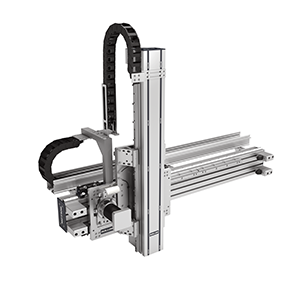
Robotics and automation applications are continually advancing, requiring engineers to specify linear motion systems capable of handling heavier payloads at higher operating speeds without compromising precision, reliability or service life.
“Inertial forces, mechanical stress, deflection and cantilevered loads significantly affect performance, precision and service life in high-load, high-speed robotics and automation applications,” explains Leon Koekemoer, BMG’s Linearway and ball screw product specialist. “Our team of specialists works closely with customers to ensure a thorough understanding of the relationship between load, speed and system dynamics when selecting linear motion solutions for demanding applications.”
One of the primary considerations is inertia. As payload mass increases, significantly greater forces are required to accelerate and decelerate moving assemblies. This becomes even more important in applications that combine substantial payloads with high operating speeds where the forces generated throughout the system increase accordingly.
Heavy loads also place greater mechanical stress on critical machine components. Linear guides, rotary bearings, rack-and-pinion systems and couplings are all subjected to higher operating forces which can reduce service life if the system has not been designed for these conditions. Selecting components with the necessary structural strength and durability plays an important role in ensuring long-term reliability.
Structural stiffness is another important consideration. Under dynamic loading, even small amounts of deflection can lead to positioning inaccuracies at the end effector, particularly when machine axes operate at their maximum reach. Prioritising actuator stiffness during system design helps minimise deflection and maintain positioning accuracy throughout the operating cycle.
Applications involving cantilevered loads introduce further design challenges. When a payload extends away from the centreline of an actuator or robot transfer unit, additional pitching moments are created. These rotational forces place extra demands on support structures, linear bearings and drive systems, while also increasing bearing friction and structural deflection. The result can be reduced repeatability and linearity, particularly where large payloads are involved.
Rollon linear motion solutions
Rollon, a specialist in the production and development of linear motion systems, recommends track-roller linear guides for dynamic applications because they combine high load capacity, stiffness and the ability to operate at elevated speeds and accelerations. Prismatic rail and other roller-based guide technologies are also suitable for harsh operating environments where contamination or aggressive conditions may be present.
For applications requiring complete actuator solutions, Rollon’s R-SMART and R-SMART-R belt-driven linear actuators are designed to transport heavy loads while maintaining high operating performance. The self-supporting extruded aluminium structures are available in widths from
Rollon’s multi-axis YZ PAR/PAS gantry systems feature self-supporting aluminium frames with high torsional rigidity and rack-and-pinion transmission. These systems can transport payloads of up to 2 000 kg over travel lengths of up to 12 m while achieving operating speeds of up to 4 m/s in applications including pick-and-place systems, industrial machine tending and logistics.
Through BMG’s partnership with Rollon, the team is able to supply and support advanced linear motion systems to meet growing demand for precision in industrial automation. BMG’s Rollon portfolio includes linear guides, telescopic rails, actuators and multi-axis systems, as well as ball screws and rotational units engineered for heavy-duty industrial operations. These components are suited to sectors including automotive assembly, electronics manufacturing, packaging, and materials handling.
Correct specification of linear motion systems for high-load and high-speed applications requires engineers to consider far more than payload capacity alone. Mechanical stress, structural deflection, cantilevered loading, inertia and overall system dynamics all influence performance, positioning accuracy and equipment life. By carefully balancing these factors and selecting appropriately engineered linear motion technologies, designers can achieve reliable, high-performance automation systems capable of meeting increasingly demanding production requirements.
For more information contact Leon Koekemoer, BMG,
| Tel: | +27 11 620 1500 |
| Email: | [email protected] |
| www: | www.bmgworld.net |
| Articles: | More information and articles about Bearing Man Group t/a BMG |






© Technews Publishing (Pty) Ltd | All Rights Reserved
 printer friendly version