



Artificial intelligence has moved rapidly from experimentation to core infrastructure, bringing with it new demands on data centres worldwide. Since the launch of ChatGPT in November 2022, the AI conversation has accelerated dramatically, evolving from early curiosity to a strategic priority for organisations across industries.
“In just three years, the landscape has evolved dramatically. At first, generative AI was all about writing emails, summarising documents and handling tedious tasks. Then last year, we started seeing agentic AI with systems that don’t just follow instructions, but begin taking stewardship over tasks. It’s exciting, but also challenging to navigate.” This is according to trend analyst and founder of Flux Trends, Dion Chang, who shared his insights at a recent joint event hosted by global leader in critical digital infrastructure solutions, Vertiv, and its customer Open Africa Data Centres (OADC).
The growing importance of available power for data centres
Chang noted that every era has its defining structures. While the 19th century had railway stations and the 20th had skyscrapers, he clarified that the 21st, in the context of the AI explosion, may be defined by data centres.
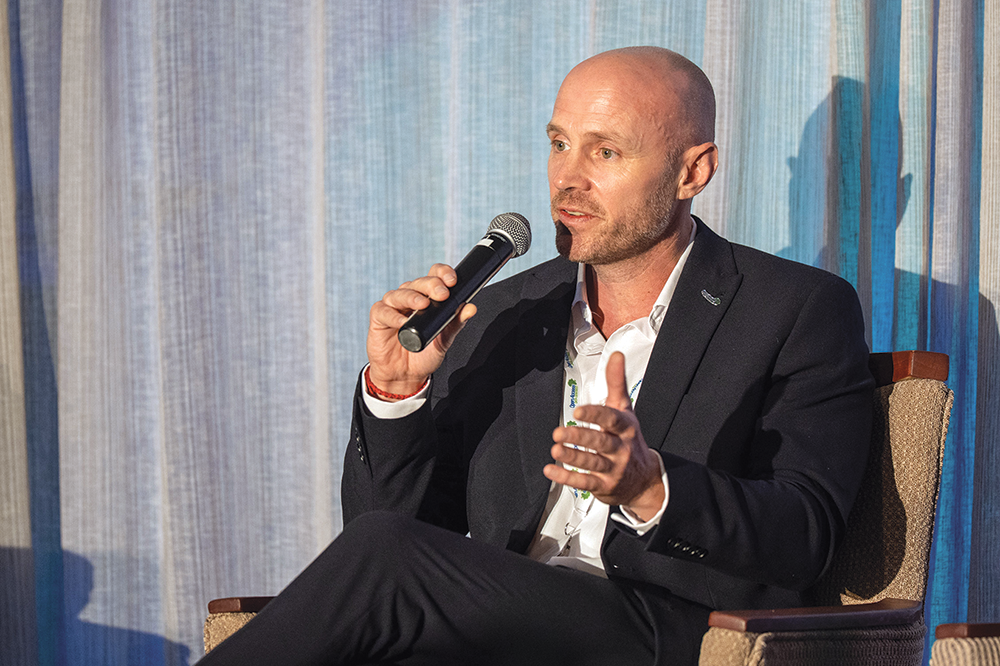
Wojtek Piorko, managing director for Africa at Vertiv, explained why, also noting the transformative impact that graphics processing units (GPUs) have had on data centres. “GPUs have evolved from graphics processors into high-performance parallel engines. To give a simple analogy, think of a CPU as a single-lane road where cars move one after another, very efficiently, but sequentially. A GPU, on the other hand, is like a multi-lane highway where thousands of cars can travel in parallel at the same time. That ability to process thousands of simultaneous calculations is what makes them so critical for AI.
“The result is a step change in density. You can now consolidate what once required multiple racks into a single rack. While that improves space efficiency, it fundamentally changes the demands on power and cooling; ultimately, how data centres are designed.”
With the advent of AI, rack densities are moving from 30 to 40 kW to potentially hundreds of kilowatts per rack in the next few years, making the supporting infrastructure of power, cooling and fibre more critical than ever. “AI deployments raise important questions,” Piorko said. “The first is power availability. AI data centres require hundreds of megawatts of additional capacity. Locally, we need to find where that power will come from and how it will interact with the grid.
“Across Africa, power generation has roughly doubled over the past decade, but is that enough? Probably not. We do have significant natural resources, including hydropower, but the challenge currently lies with power distribution, something many of us in South Africa particularly know very well.”
Africa in focus: connectivity, edge and flexibility
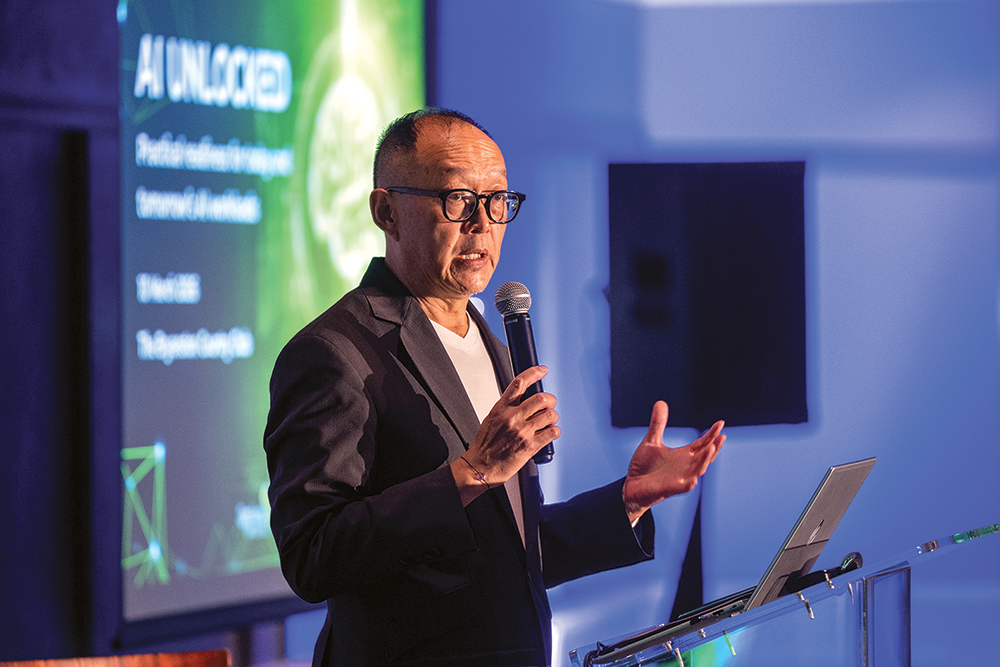
Piorko added context to the African data centre scenario. “Africa currently has less than half a gigawatt of active white space capacity for a population of over a billion. To put this into perspective, Dubai alone has the same capacity as our entire continent. This shows that, while the opportunity in Africa is enormous, we do need factors like stable power, regulatory alignment, connectivity and skills in place to catch up.”
Marc Matthews, engineering director and head of projects at OADC explained that it is possible to meet these requirements in Africa, referring to OADC’s own recent achievements within the continent. “Our business model is slightly different, with OADC’s site in Amanzimtoti, South Africa, functioning primarily as a cable landing station. This highlights a key point: data centres are nothing without connectivity. You can have huge computing capacity, but without access to subsea cables and global networks, the data cannot reach users. That’s why our facilities across Africa are strategically located near subsea cable landing points and terrestrial fibre networks.”
Agreeing that one of the biggest shifts in the local industry is the move toward edge computing, Matthews commented: “If someone in Johannesburg asks an AI system for restaurant recommendations, they shouldn’t have to wait minutes for a response from a data centre on another continent. AI inference needs to happen closer to the user, and this is why we’re seeing the rise of Edge data centres across Africa.”
Furthermore, Matthews stated that environmental consciousness need not be just a buzzword. “In Nigeria, OADC is exploring gas-based power generation as an alternative to diesel, while in South Africa, we have solar panels that offset energy use for one data hall during daylight hours. Operational tweaks, like adjusting cooling setpoints slightly, can also yield significant energy savings.” He also stressed that water concerns in Africa are often misunderstood, saying that modern cooling systems operate in closed loops, meaning the same water is reused repeatedly.
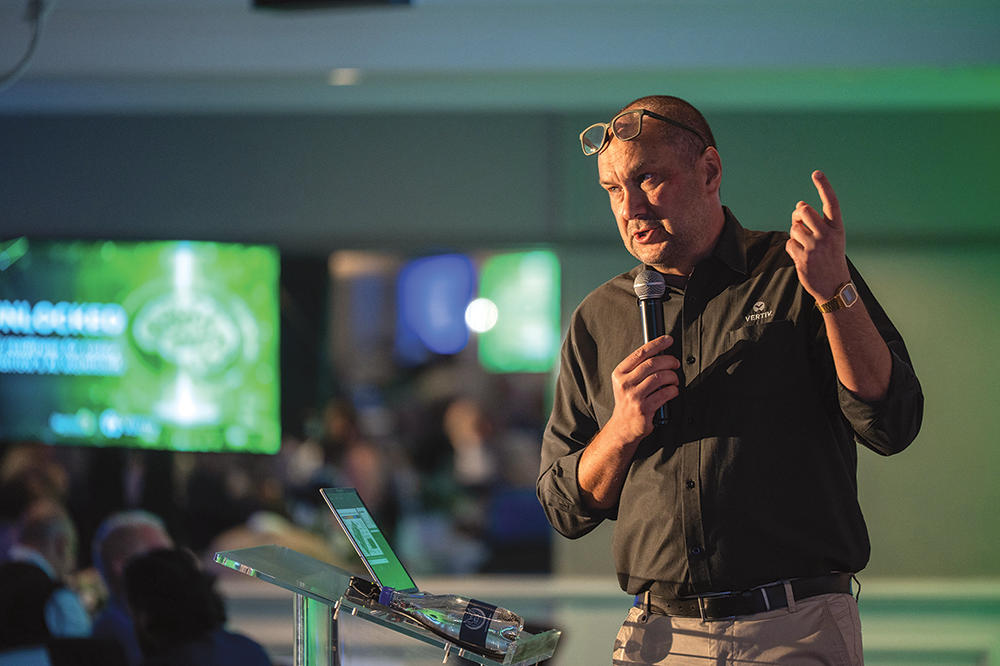
This point was confirmed by Piorko, who referred to the recently launched system called VertivTM SmartRun, a converged overhead IT infrastructure system which integrates high-density power distribution, closed-loop liquid cooling, networking and containment infrastructure in an all-in-one deliverable platform. In this design, all infrastructure above the rack is pre-designed and modular.
“This allows much faster and more efficient deployment,” Piorko continued. “In fact, our broader philosophy is modularity. Components are pre-designed, manufactured and tested in factories before being shipped to the site. That reduces risk, speeds up deployment and minimises construction waste.”
This type of modularity has played a key role in the design of OADC’s facility in Lagos, Nigeria, which, according to Matthews, reflects a flexible, phased approach to infrastructure deployment. “Initially planned as a 24 MW facility, we opted to start with 6 MW, scalable to 24 MW later. This decision is based on the concept of designing facilities that can support both today’s workloads and tomorrow’s AI demands.”
Looking ahead
Together, these approaches point to a more scalable and resilient model for data centre development in Africa, one that balances current demand with the evolution AI will place on infrastructure in the years ahead.
For more information contact Nicola Read, icomm, [email protected], www.vertiv.com,/a>






© Technews Publishing (Pty) Ltd | All Rights Reserved
 printer friendly version