



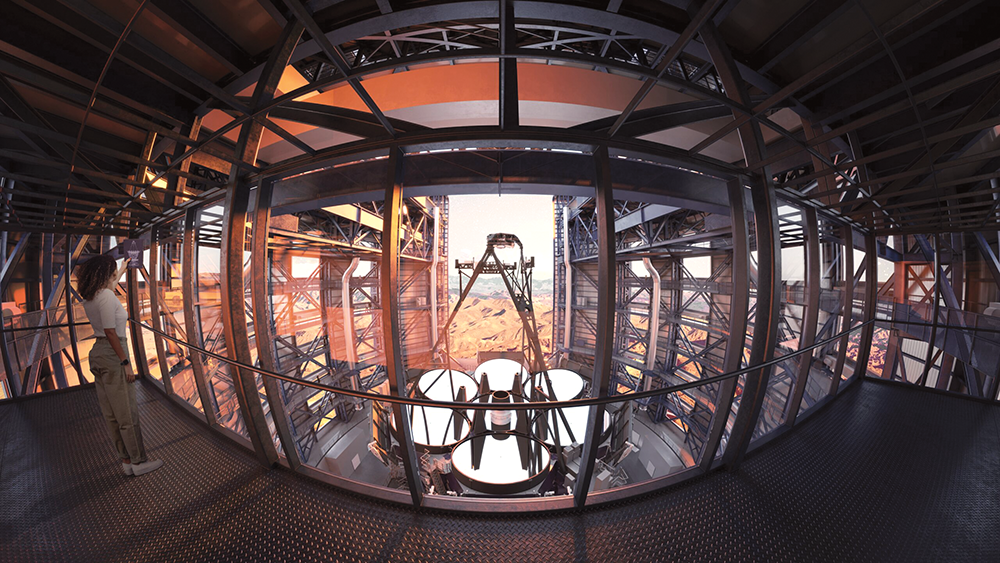
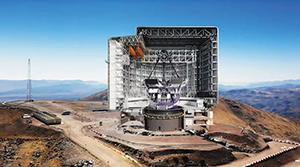
Construction of the Giant Magellan Telescope, set to become the world’s largest Gregorian optical infrared telescope, is well underway. While its scientific mission is to transform astronomy, its performance depends heavily on advanced mechanical, hydraulic and pneumatic engineering. Beneath its optical systems lies a sophisticated combination of hydrostatic bearings, hydraulic damping, pneumatic mirror supports, and precision-machined structural components designed to deliver extraordinary stability and accuracy.
The observatory is currently expected to achieve first light toward the end of the decade, with completion targeted around 2030. Once complete, it will be up to 200 times more powerful than current instruments. Its optical system consists of seven 8,4 metre spin-cast borosilicate honeycomb mirrors arranged to create a 25,4 metre aperture. Supporting and controlling this massive optical assembly requires one of the most advanced telescope mount systems ever built.
Central to the telescope’s motion platform are hydrostatic bearings fitted to both the azimuth and elevation axes. These bearings support the telescope as it rotates horizontally and tilts vertically, allowing the 2600 ton structure to move with exceptional smoothness. The hydrostatic system enables the mount to float on a 50 micron thick film of hydraulic oil, roughly the thickness of a human hair.
Hydrostatic bearings were selected for their ultra-low friction, high stiffness and compatibility with the telescope’s hydraulic damping system. Unlike hydrodynamic bearings, which generate lubricant pressure through relative motion, hydrostatic bearings rely on externally pressurised oil supplied continuously between bearing pads and precision-machined raceways. This creates a constant fluid film that keeps moving surfaces separated at all times.
The result is extremely low static and dynamic friction, minimising wear, heat buildup and vibration. For a telescope required to track objects billions of light years away, even slight vibration or thermal distortion can reduce image quality. The hydrostatic bearing arrangement provides both smooth movement and long-term reliability.
High stiffness is equally important; the bearings resist deformation under load, helping the telescope maintain precise pointing accuracy while tracking celestial targets. This rigidity supports both stable positioning and dynamic performance during operation.
The hydraulic bearing circuit also gives seismic protection. Because the telescope will operate in Chile where earthquakes are a concern, the hydraulic infrastructure used for the hydrostatic bearings is integrated with the telescope’s damping and isolation system. Large hydraulic dampers act as shock absorbers providing vertical isolation and dissipating seismic energy to protect the structure.
Manufacturing the telescope mount has required exceptional machining precision. Standing 39 metres tall and weighing 2600 tons, the telescope is among the largest and most precise moving structures ever engineered. To produce it, specialised heavy-machining facilities and dedicated assembly infrastructure have been developed.
The azimuth track assemblies, which guide horizontal rotation, each weigh over 22 000 kg and must be machined to extremely tight tolerances. The hydrostatic guideway surfaces where the bearing pads ride require near-perfect flatness across very large diameters to maintain the integrity of the oil film and ensure uniform load distribution.
Large five-axis gantry machining systems are being used to machine these components. Final finishing of radial and hydrostatic bearing surfaces is performed using specialised in-place machining equipment capable of grinding and turning large-diameter bearing surfaces directly on the assembly floor after structural assembly. This reduces cumulative alignment error and improves final accuracy.

The telescope’s elevation motion is supported by a massive C-ring structure that allows the optical assembly to tilt vertically. This structure must maintain dimensional stability while carrying the weight of the mirrors and upper optical systems under constantly changing gravitational loads.
Mounted above the primary mirror structure is the Gregorian Instrument rotator, a 9,4 metre diameter rotating platform carrying the telescope’s scientific instruments. It incorporates a 117 ton low-friction roller bearing assembly to maintain instrument alignment during tracking.
The mirror support system is another major mechanical engineering feature. Each of the seven primary mirrors weighs approximately 20 tons and is mounted in a support cell equipped with more than 300 pneumatic actuators. These actuators form part of the active optics system, continuously applying controlled support forces to the back of each mirror.
As the telescope changes orientation, gravitational forces acting on the mirrors shift, and the pneumatic actuators adjust in real time to compensate for these changes, preserving the mirrors’ optical shape and ensuring the seven segments function as a single coherent optical surface.
Although designed for astronomy, the telescope is fundamentally a large-scale precision machine. The project is a landmark in mechanical engineering, demonstrating how advanced hydraulics, pneumatics and precision manufacturing are the basis of some of the world’s most demanding scientific infrastructure.
For more information visit www.giantmagellan.org






© Technews Publishing (Pty) Ltd | All Rights Reserved
 printer friendly version