



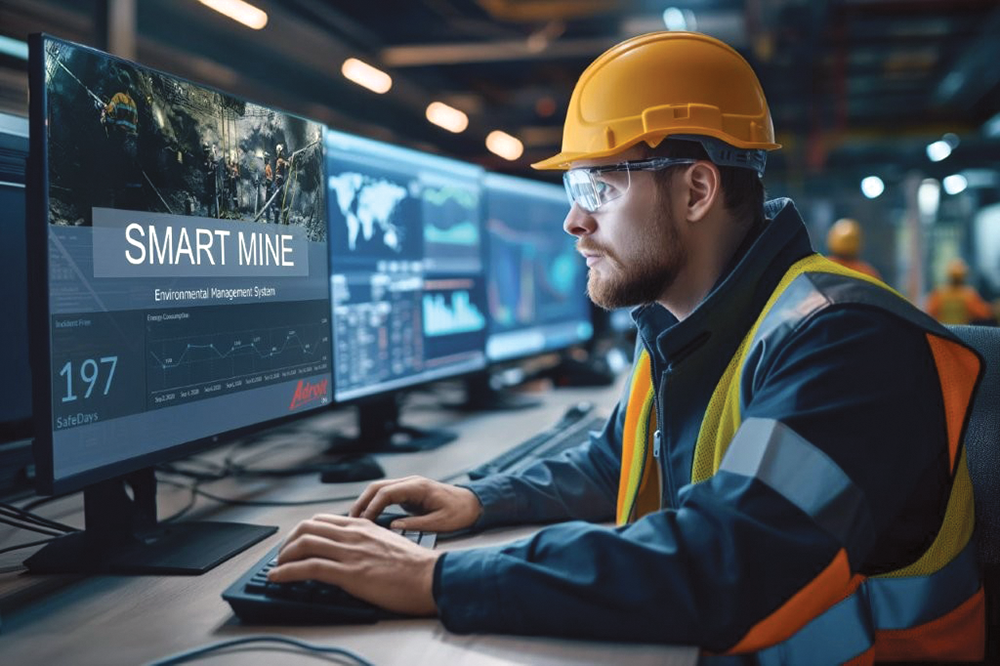
As mining operations become deeper, more mechanised and increasingly data-driven, the role of technology in safeguarding workers and ensuring regulatory compliance has never been more critical. For proudly South African industrial software leader, Adroit Technologies, this shift has driven the evolution of its environmental management and safety system (EMS) into a fully integrated, enterprise-level platform that supports both real-time safety and long-term occupational health.
According to Hugo Pienaar, director of Digital Services at Adroit Technologies, the company’s journey in mining safety is rooted in decades of industry transformation. “We have traditionally played a large role in the mining industry from a SCADA and automation perspective,” he explains. “These systems have always enabled real-time monitoring, particularly around critical safety elements like fire detection.”
From legacy systems to integrated intelligence
South Africa’s mining sector has a unique history in safety innovation, particularly in underground environments. Early developments, many pioneered by large mining houses, laid the foundation for modern fire detection and monitoring systems. However, as ownership structures changed and in-house R&D; declined, many operations were left with fragmented, unsupported legacy systems.
Adroit identified this gap and worked to bridge it. “We were approached to integrate legacy systems onto a modern platform and make provision for new technologies,” says Pienaar. “What we developed was not just a replacement, but a scalable, standardised EMS solution.”
At the core of this approach is flexibility. The system allows mines to integrate a wide range of sensors and equipment through configurable plug-ins, regardless of manufacturer. “Irrespective of the equipment, we provide a platform that communicates with those devices,” notes Pienaar. “It becomes a standardised layer across very diverse operations.”
Safety as a catalyst for technological advancement
The modernisation of mining safety cannot be separated from regulatory pressure and industry-wide reform. South Africa’s push to reduce fatalities, particularly during the early 2000s, was a turning point. “There was a very distinct drive around mine safety,” Pienaar says. “Fatalities were extremely high at one stage, and that forced a major shift in how safety systems were implemented and monitored.”
Today, that legacy continues, but with new dimensions. While acute risks such as fire and gas detection remain critical, there is growing emphasis on occupational health, environmental exposure and the integration of digital technologies across the mining value chain.
This shift is also reflected in the rise of Adroit’s Smart Mine initiative, where real-time data, automation, and connected systems are used to improve both safety and operational efficiency. By integrating EMS capabilities into a broader digital ecosystem, mines can move beyond reactive safety measures towards predictive risk management, enabling faster decision making and greater visibility across the entire operation.
“The onus has shifted,” explains Pienaar. “Operations now need to prove that workers were not exposed to harmful conditions, rather than the other way around. That requires deep, continuous data recording and analysis.”
Expanding into occupational health and environmental monitoring
Adroit’s EMS platform has evolved to address these emerging requirements. Beyond real-time alerts, it now incorporates advanced reporting and decision-support tools that track long-term exposure to factors such as dust, noise and diesel particulates.
“These are now part of mining licences and social responsibility frameworks,” says Pienaar. “There is no option as mines must monitor and report on these conditions.” The system captures and aggregates data from both fixed and portable sensors, enabling comprehensive exposure analysis.
“We are extending the system to record and analyse long-term, time-weighted exposure data,” he adds. “That is essential for compliance and for protecting worker health.”
Enabling the future of autonomous and connected mining
As mining operations become more automated, the reliance on digital systems intensifies. Mechanised and autonomous mining environments introduce new risks, but also new opportunities, for integrated monitoring.
“In autonomous mining, you are relying on systems 100% as there is no human intervention,” says Pienaar. “That increases the importance of robust detection and monitoring platforms. At the same time, the rise of industrial IoT is expanding the scope of EMS systems. You now have asset tracking, people tracking, and a wide range of connected devices feeding into the system,” he says. “It creates a far more comprehensive view of the operation. Adroit’s platform is designed to accommodate this complexity, functioning not only as a safety system, but also as a broader information management solution. It is not just an EMS system, but a full enterprise suite. We can integrate safety data with operational systems, enabling better decision making across the mine.”
Driving standardisation in a fragmented industry
One of the key challenges in mining remains the lack of uniform standards, particularly in emerging areas such as environmental exposure monitoring. “We have been involved in standards development, including SANS 1515 for underground early warning systems,” says Pienaar. “But in some areas, regulation is still catching up.”
In this context, technology providers play an important role in shaping best practice. “We are effectively helping to establish a standard through the platform itself,” he notes. “It provides consistency across operations, even as ownership and personnel change.”
A scalable solution for a changing industry
As the mining sector diversifies with a growing number of junior and independent operators, accessibility and scalability have become critical. Adroit’s EMS system is designed to be equally applicable to large mining houses and smaller operations.
“Our pricing model is consistent, and we don’t differentiate based on device type,” says Pienaar. “That makes the system accessible and scalable across the industry.” Importantly, the platform is built to evolve alongside technological advances. “We do not replace systems, we extend them,” says Pienaar. “Whether it is edge computing, IoT or future AI capabilities, it is about adding value to what already exists.”
Safety, data and the bottom line
While safety remains the primary driver, the business case for advanced EMS systems is equally compelling. Downtime resulting from safety incidents can have severe financial consequences. “If a safety system fails, operations can be stopped and evacuated,” says Pienaar. “In some cases, that can wipe out margins for the year.”
By contrast, improved monitoring and early detection not only enhance safety, but also support operational continuity and efficiency. “Data is gold. It drives both safety and performance. The evolution of mining safety is not a one-off transformation, but an ongoing process. It is a journey, and we work with our clients to manage that journey, adapting to new risks, new technologies and new regulatory requirements,” concludes Pienaar.
As the industry continues to modernise, integrated EMS platforms like Adroit’s are set to play a central role, ensuring that safety, sustainability and productivity advance together.
| Tel: | +27 11 658 8100 |
| Email: | [email protected] |
| www: | www.adroitscada.com |
| Articles: | More information and articles about Adroit Technologies |






© Technews Publishing (Pty) Ltd | All Rights Reserved
 printer friendly version