



Whether in silos, tanks or process containers, the exact detection of fill levels is crucial for stable, safe and economical production processes. However, many common measuring methods quickly reach their limits in practice.
In sectors such as the food, chemical and pharmaceutical industries, precision is one of the key requirements in daily production operations. Reliable level measurement plays a decisive role, whether it is to avoid being overfilled, to ensure material availability for dosing processes or for continuous process control. The selection of suitable measurement technology depends on a variety of influencing factors, from product properties and structural conditions to regulatory requirements in sensitive areas. A central requirement is to reliably and accurately determine the actual content of a container under all conditions, regardless of shape, medium or environment.
Traditional measuring methods and their limitations
In practice, various measuring principles are used, from radar and microwave sensors to ultrasonic and capacitive methods through to hydrostatic or optical systems. However, many of these technologies only record an indirect measured value such as the distance to the surface or the pressure at the bottom of the container from which the fill level is calculated. This inevitably leads to uncertainties, for example in the case of foam or bridge formation, uneven pouring cones, caking or variable density.
Industrial experience at the chemical company Solvay Fluor in Frankfurt shows the practical limits of conventional systems. There, non-contact measuring methods led to unsatisfactory results, as changes in temperature and density severely impaired accuracy. The solution was only found by retrofitting the PanCake load cells series by Minebea Intec, a leading global manufacturer of weighing and inspection technologies, which enabled precise and reliable level measurement by weight, with a maximum deviation of just 1,1%, compared to around 2,5% with the previous methods.
Objective, non-contact, precise gravimetric measurement
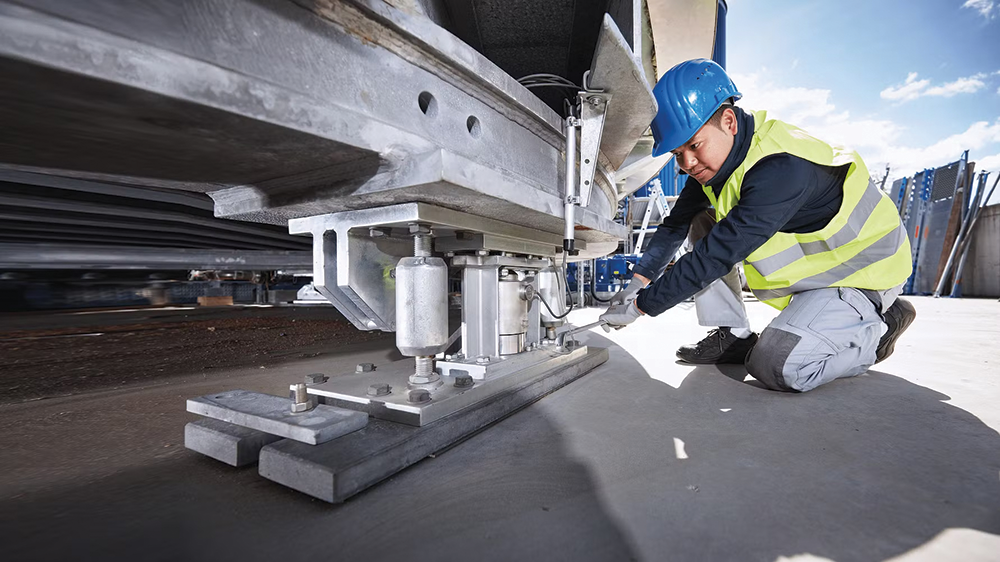
Unlike other methods, gravimetric level measurement does not measure a derived process signal, it measures the mass. Load cells such as the PanCake or Inteco record the weight of the entire container including its contents, regardless of material properties, density changes or form factors. The result is a consistently precise, linear measurement across the entire filling range, even with demanding media such as viscous liquids, bulk materials or aggressive chemicals.
Another advantage is that the sensor technology is located completely outside the container. This eliminates the need for perforation of the container, which means the elimination of the effects of incrustations, corrosion and error-prone calibrations. This is particularly important for hygiene-critical applications in food or pharmaceutical production. Load cells in hygienic design are CIP/SIP-capable, cleanroom-compatible and have been developed in accordance with EHEDG and FDA requirements.
Process reliability and cost-effectiveness
The PanCake load cells have been specially developed for retrofitting and integration into existing systems. They can be installed quickly and without any structural changes to the container, a clear advantage over alternatives such as radar or ultrasonic technology. Internal analyses and market comparisons show savings of up to 50% can be achieved even on the acquisition costs.
Level monitoring under extreme conditions
Whether in potentially explosive atmospheres or at highly fluctuating temperatures, gravimetric weighing systems that use sensors such as the PanCake load cells are certified for extreme conditions (ATEX, IECEx) and offer maximum safety. In industries, such as the chemical industry, where toxic, highly flammable or highly viscous media are used, this is a decisive advantage. At Solvay Fluor, the introduction of PanCake load cells has not only improved process safety, but has also demonstrably made the entire level measurement process more efficient.
Future-proof through digital integration
Another advantage of gravimetric systems is their digital connectivity. Modern weighing electronics such as the MiNexx weighing indicators can be easily integrated into existing control systems, whether via analogue interfaces or digital standards such as ProfiNet, Ethernet/IP or Modbus. This makes level control part of a higher-level control and quality management system with real-time data, traceability and complete process documentation.
Mass is the true benchmark
The requirements for modern level measurement are increasing, as is the complexity of industrial processes. Methods such as radar or ultrasound quickly reach their limits. Gravimetric systems, on the other hand, offer an objective, accurate and economical solution, regardless of media, container shapes or environmental conditions.
With solutions such as the PanCake load cell or the Inteco load cell, Minebea Intec supplies tried-and-tested technologies that make the difference. They not only offer maximum accuracy and process reliability, but also genuine cost-effectiveness over the entire lifecycle. At a time when production safety, efficiency and hygiene are a requirement, weighing technology is the benchmark against which modern solutions for fill level determination must be measured.
For more information contact Minebea Intec,






© Technews Publishing (Pty) Ltd | All Rights Reserved
 printer friendly version