



According to Senseca South Africa managing director, Jan Grobler, measurement technology plays a critical role across a range of industries such as aviation, ports, harbours, plant and mining. This is especially true when supplying accurate and reliable data for road management entities that assist drivers of vehicles experiencing hazardous weather conditions.
“Multiple fatal car and truck accidents are increasing as a result of unexpected severe flooding, hailstorms and misty road conditions that continue to wreak havoc across South Africa as weather patterns change, often at short notice. Transport departments, municipalities and private route and road management institutions have limited or irregular access to up to date, accurate and critical road weather measurement data and systems,” he says.“Advanced technology can reduce the current vehicle carnage dramatically. Our state-of-the-art RWS-20 Road Weather Sensor from Biral in the United Kingdom, part of the Senseca Group, is globally recognised as the leader in the field of weather measurement technology”.
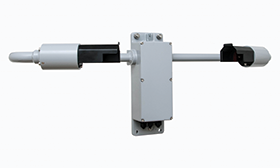
He adds that weather measurement technology brings great benefits to those who manage road networks in South Africa and those who use the roadways. Biral has developed the RWS-20 Road Weather Sensor, specifically designed for use in road applications where accurate and reliable visibility measurements are required. This has become a key component of any road weather information system (RWIS).
The RWS-20 operates on the forward scatter principle. Its unique design ensures that output is both accurate and reliable in all weather conditions and is not influenced by local light sources, headlights or flashing signs and beacons. The forward scatter principle is widely accepted and has significant advantages over more traditional techniques such as the use of transmissometers or backscatter sensors.
What is RWS-20?
Any sensor or measurement system located at the side of main arterial roads and freeways has to be able to withstand dirty and potentially corrosive environmental conditions while operating independently and for extended periods of time, as access can often be restricted. The RWS-20 visibility sensor is specifically designed for harsh roadside conditions.
The sensor housing is a very robust aluminium enclosure which is sealed against dirt and water ingress (IP66/67) and designed to withstand the rigours of 24/7 unattended operation. The measurement windows are protected by hoods which are designed to reduce the amount of dirt and external light reaching the optics.
The 10 metre to 7,5 km measurement range is optimal for use in road applications where fog, mist, heavy rain, surface spray and snow can cause dangerous driving conditions due to reduced visibility. Heating of the optical windows prevents misting and optional sensor hood heating can be provided allowing for use in the harshest of conditions. Both optical windows are monitored for contamination and the visibility output is automatically compensated to reduce maintenance requirements.
Features
In addition to the serial data interface, the RWS-20 sensor provides analogue voltage output and optional current outputs of visibility (MOR) or extinction coefficient (EXCO). Optional relays provide threshold and self-test switching capabilities. Features include:
• Optional 4-20Ma and relay outputs.
• Comprehensive self-test capabilities.
• Window heating and contamination monitoring.
• Compact forward scatter design.
• 10 to 7500 metre measurement range.
• Optional hood heating for use in extreme winter environments.
• Analogue voltage output (0-10V).
• Easy to use with ASCII text data messaging.
• Serial data output (RS232, RS422 or RS485).
• Selectable measurement resolution of 1 metre or 10 metre (default).
• Two-year warranty.
Optional relays provide a direct connection to roadside signage or to a data logger or other control system allowing the sensor to intelligently and independently operate local warning systems. “This transmitting of vital data and information straight to emergency and road traffic warning systems together with auto-correct measurements for accuracy can play a huge role in changing driver behaviour in order to avoid multiple vehicle pile-ups on our roads in hazardous weather conditions. This would be a giant step for road users in South Africa. Vehicle operators need accurate and reliable information as much in advance as possible ,and the RWS-20 delivers this” says Grobler.
It is not only roadway systems that can benefit from the RWS-20. Ports and harbours are subject to heavy fog, mist and rainstorms. Mines also require dust suppression sensors in order to lower the level of dust on site.
Biral also supplies the SWS-100 versatile sensor used by the United Kingdom’s MetOffice. In the aviation sector the SWS-100 is utilised for both general visibility monitoring and as part of instrumented runway visual range (RVR) systems.
| Tel: | +27 11 902 0158 |
| Email: | [email protected] |
| www: | www.senseca.com |
| Articles: | More information and articles about Senseca |






© Technews Publishing (Pty) Ltd | All Rights Reserved
 printer friendly version