


Motion Control & Drives


Turbomachinery controls: the call of duty

February 2025 Motion Control & Drives

There’s a lot to be said about the unsung heroes of this world; those men, women and machines that deliver such important functions, often overlooked and recognised. One such machine is turbomachinery, and while the name does sound quite obvious to the layman, its rich history and daily functions are not.

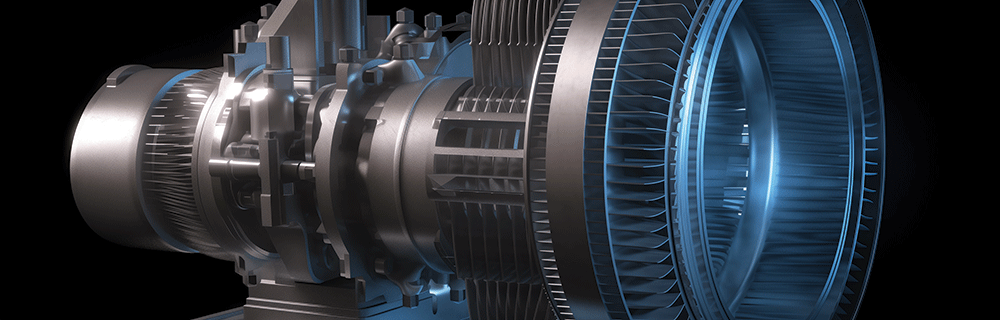
Turbomachinery today refers to machines that transfer energy between a rotor and a fluid, including both gases and liquids. It includes devices like turbines, compressors and pumps. Turbomachinery also plays a crucial role in power generation, aviation and many industrial processes.

What’s fascinating is that turbomachinery’s history spans centuries. In fact, the earliest forms of turbomachinery can be traced back to water wheels, which appeared the around the first century BC in the Mediterranean region. Fast forward to the 1930s where the first gas powered turbines lit streetlights, later finding applications in aviation and power generation. Now, almost a century later, turbomachinery can be found in most industrial settings. And at the heart of it all are advanced control systems which not only enhance current turbomachinery operations, but take it to a whole new level.


Kobus Vermeulen, direct sales executive, Process Automation at Schneider Electric.

Turbomachinery faces modern challenges

Turbomachinery’s role is vital, we’ve established as much, which means continuous operations are a non-negotiable. However, a number of factors add layers of complexity to today’s turbomachinery’ operations:

• Efficiency optimisation: Rising energy costs and pressure to minimise carbon footprints make it imperative to optimise machinery performance and reduce waste.

• Regulatory compliance: Most industries have to meet stringent emissions and environmental standards which require precise machinery controls to achieve compliance without sacrificing efficiency.

• Industry 4.0 integration: The shift toward smart manufacturing demands control systems that integrate seamlessly with IoT devices and data analytics platforms, enabling real-time decision making and enhanced connectivity.

• Dynamic operating conditions: Fluctuating loads and diverse operational scenarios require adaptive systems capable of maintaining stable and efficient performance.

The control benefits are real.

Turbomachinery control solutions truly assist organisations by not only optimising performance, but also by reducing energy consumption- a universal operational benefit.

From an environmental perspective, modern turbomachinery control solutions play an essential role in emissions reduction and resource optimisation. These systems provide precise control over emissions and waste, helping organisations comply with strict environmental regulations. By improving machinery efficiency, turbomachinery control systems also reduce resource usage, again aligning with sustainability goals.

When arguing the case for automated robotic systems, safety is often cited a major benefit. The same can be said for turbomachinery control systems, which offer real-time monitoring and diagnostics, enhancing workplace safety.

Automated safety protocols also mitigate risks by reducing reliance on human intervention, thereby minimising the chance of errors and ensuring safe operations.

In action

At Schneider Electric our Turbomachinery Control (TMC) solutions are optimised for generators, compressors and drives. These solutions include anti-surge control, performance control, load sharing and decoupling control to optimise efficiency and stability.

A major advantage is that Schneider Electric’s TMC solutions offer mechanical retrofit capabilities, which means that organisations can upgrade aging control systems, thus improving machine performance and extending the lifecycle of turbomachinery.

Our TMC solutions also incorporate advanced algorithms with process automation strategies to protect compressors from surging, ensuring smooth operation.

And lastly, Schneider Electric TMC solutions offer safety and reliability features which are designed to reduce the risk of catastrophic failures and process disruptions, enhancing overall plant safety and productivity.


Credit(s)


Share this article:
Share via emailShare via LinkedInPrint this page

Further reading:

Solving common automation challenges with Festo’s servo drive and servo motor solutions
Festo South Africa Motion Control & Drives
Automation projects face challenges that include limited installation space, the need for precise and repeatable linear motion, rising cycle-speed demands, and seamless integration with existing control architectures. Festo’s servo portfolio directly addresses these issues with compact, modular drive and motor solutions designed for specific applications.

Read more...
Inside the Giant Magellan Telescope with mechanical engineering at astronomical scale
Motion Control & Drives
Construction of the Giant Magellan Telescope, set to become the world’s largest Gregorian optical infrared telescope, is well underway. While its scientific mission is to transform astronomy, its performance depends heavily on advanced mechanical, hydraulic and pneumatic engineering.

Read more...
Filtration as a reliability driver in motion control systems
Parker Hannifin - Sales Company South Africa Motion Control & Drives
This article highlights the importance of filtration in motion control systems, how contamination affects performance, and what fleet managers, operators and maintenance teams in southern Africa can do to reduce downtime, avoidable wear and costly repairs, aided by Baldwin Filters.

Read more...
How smart signalling can transform Africa’s manufacturing future
Schneider Electric South Africa Industrial Wireless
Imagine a factory floor where humans and machines communicate in real time with issues flagged instantly, workflows adjusted seamlessly and downtime reduced to near zero. This is the reality unfolding across Africa as manufacturers embrace the next generation of intelligent signalling technologies.

Read more...
Supporting construction of next-gen floating offshore wind turbines
Motion Control & Drives
While windy locations naturally make ideal spots for offshore wind farms, they bring challenges when it comes to assembling wind turbines, particularly in ports. Mammoet was approached by Euroports to support with the marshalling and assembly of the components that make up the three turbines at Port-la-Nouvelle in France.

Read more...
Rollers excel where profits balance on a knife edge
igus Motion Control & Drives
Polymer component specialist manufacturer, igus has developed a range of lubrication-free long-life knife edge rollers designed to improve the transfer of products between conveyor belts in high-speed production environments.

Read more...
Bringing physical AI to the factory floor by deploying humanoids in industrial operations
Siemens South Africa Motion Control & Drives
Siemens and Humanoid have marked a landmark milestone in the journey to bring physical AI from vision to industrial reality. Humanoid’s humanoid robothas been successfully tested in operations at Siemens’ electronics factory in Germany, performing autonomous logistics tasks.

Read more...
Unpacking the technoeconomic case for cleaner power in wastewater plants
Schneider Electric South Africa Electrical Power & Protection
Behind every reliable wastewater plant is an electrical system exposed to the effects of harmonics, voltage distortion and overloaded networks caused by fleets of variable speed drives on pumps and aerators.Together, they steadily drive up maintenance demands and elevate the risk of failure.

Read more...
Next-generation oil-free motor systems with active magnetic bearings
WEG Africa Motion Control & Drives
WEG and SpinDrive are collaborating to integrate SpinDrive’s AMBs and built-in IoT condition monitoring into WEG’s market-leading electric motor offering, creating an oil-free, maintenance-free drive solution.

Read more...
Rising demand for advanced coolant technology
Motion Control & Drives
As modern engines become smaller, more powerful and increasingly complex, coolant technology has undergone a fundamental transformation.

Read more...


While every effort has been made to ensure the accuracy of the information contained herein, the publisher and its agents cannot be held responsible for any errors contained, or any loss incurred as a result. Articles published do not necessarily reflect the views of the publishers. The editor reserves the right to alter or cut copy. Articles submitted are deemed to have been cleared for publication. Advertisements and company contact details are published as provided by the advertiser. Technews Publishing (Pty) Ltd cannot be held responsible for the accuracy or veracity of supplied material.


© Technews Publishing (Pty) Ltd | All Rights Reserved

