



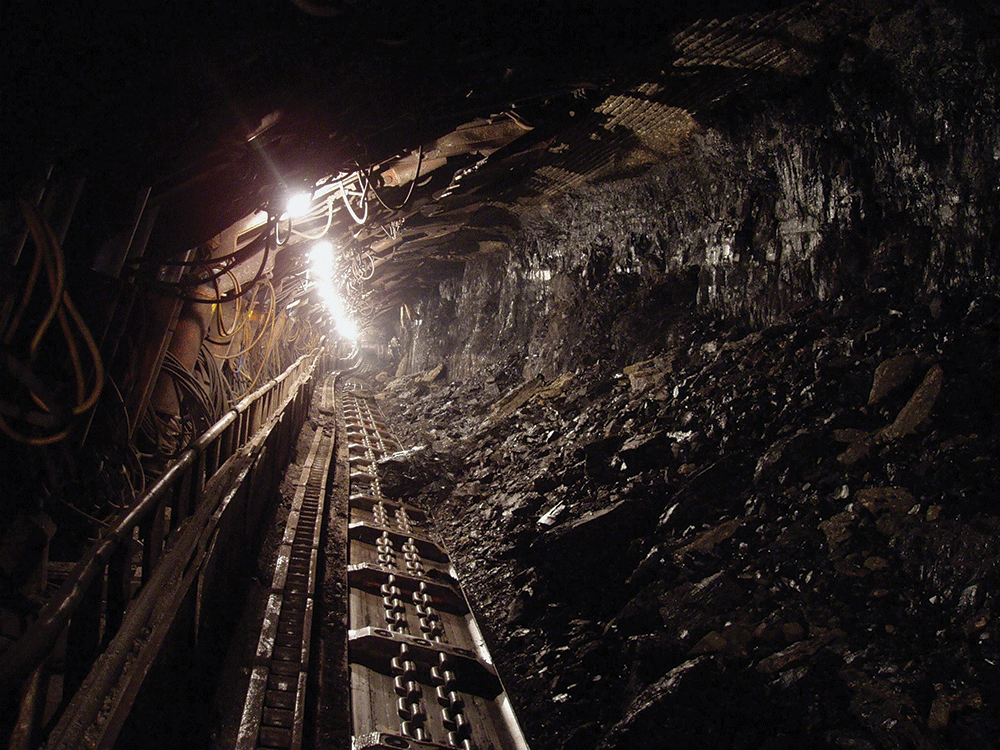
Wireless telemetry systems are a valuable tool in the mining industry to facilitate automation, data collection, communication, and remote monitoring and control in challenging environments. This is increasingly important as mine operators struggle to keep up with soaring operating and maintenance costs and declining ore quality, which are drastically reducing industry-wide efficiency. Ian Loudon, international marketing manager at wireless telemetry specialist, Omniflex explains how wireless telemetry systems can automate water pump monitoring and control in the mining sector.
Telemetry systems can be used in mining environments to provide continuous monitoring and real-time transmission of critical parameters such as temperature, humidity and gas levels, and resource extraction metrics. They also allow mine operators to track worker locations and monitor hazardous environment conditions, like toxic gases or unstable ground levels to enhance safety protocols.
Furthermore, these systems are increasingly important from an environmental compliance perspective. For example, they can monitor factors such as dust levels, groundwater contamination and noise pollution to ensure adherence to regulatory standards set by South Africa’s Department of Water Affairs or the Department of Mineral Resources and Energy.
By staying up to date with all the relevant regulations set by these bodies and more, mine operators can ensure they remain compliant, safe and environmentally responsible. Failure to do so can lead to expensive fines and costly disruptions to operations.

Managing district mines
Regulations set by South Africa’s Department of Water Affairs are particularly important for the nation’s district mines, which are generally located in remote, arid areas and rely on pumps at boreholes to draw groundwater and supply on-site water tanks. District mine operators are often limited on the amount of hours a day they can pump water as the resource must be carefully managed to allow the ground water sufficient recovery time in-between uses.
Another common challenge in these environments is that mines often experience power outages due to the damage of power lines or scheduled loadshedding from the national grid. This means that all equipment must be robust and come with contingency plans in case of an outage.
Another issue in these environments is that operators typically rely on aging infrastructure and outdated equipment, leading to higher operating and maintenance costs, making regulatory compliance more difficult to manage. These problems combined mean that mine operators are now increasingly on the hunt for ways to improve on-site efficiency and increase profitability.
Automating borehole pump management
We recently delivered a project to a large district mine in South Africa where we were tasked with automating the borehole pump management system, based on the monitored tank levels. This meant that whenever the tank level got low, the borehole pump would automatically switch on, and once tank levels reached acceptable levels switch itself back off.
We provided the mine with a Teleterm M3 module in a box, installed at the water tank. The module was DC-powered, and monitored water levels from sensors located inside the tank. These sensors communicated wirelessly with the module placed at the borehole. We provided an Ethernet connection from the M3 to the mine’s scada system, enabling operators to monitor and control the system from the central room and read all relevant system data from there.
This enhanced oversight was particularly beneficial in terms of data reporting and resource allocation, also improving compliance with Department of Water Affairs’ regulations.
The module supplied for the borehole site was one of our Teleterm D3s. This device features a built-in display showing the water tank level, giving engineers at the borehole an accurate indication of system readings. This meant operators could trust that the borehole pump was automatically switching on and off as intended. The D3 is AC-powered, offering built-in battery backups, and in the event of a power failure, can report using the wireless link.
Omniflex has over 60 years experience in providing telemetry solutions for mining operations globally, and is well placed to assist with any challenge you face with the collection and management key operational data.
| Tel: | +27 31 207 7466 |
| Email: | sales@omniflex.com |
| www: | www.omniflex.com |
| Articles: | More information and articles about Omniflex Remote Monitoring Specialists |






© Technews Publishing (Pty) Ltd | All Rights Reserved
 printer friendly version