



Africa is poised for massive expansion in the power, energy, and communications spheres, and hot dip galvanising is firmly entrenched as a preferred corrosion control technology in these sectors, according to Robin Clarke, executive director of the Hot Dip Galvanisers Association of South Africa (HDGASA).
In light of this, and due to their kettle size and entrenched quality systems, many South African galvanisers are well suited to galvanise large structural articles, enabling them to partner successfully with progressive engineering and construction companies working throughout Africa. Consequently, sectors such as mining, irrigation and warehousing are well serviced. “A further area under development, in conjunction with companies specialising in duplex coatings, is hot dip galvanised articles that are overcoated with carefully selected organic coatings,” he adds.
Clarke advises that duplex coatings have extended into the sphere of architectural requirements, or requirements for extra coating thicknesses in extremely harsh environmental conditions. A good example is that of a façade for a bank in Mozambique, which required exceptional corrosion resistance and also aesthetic appeal.
Clarke says that few hot dip galvanising plants north of South Africa have enjoyed sufficient volumes to allow for sustained utilisation of their facilities or justified investment in equipment and training. Developmental opportunities related to infrastructure spend may change this, particularly if governments promote local content development.
“This requires the HDGASA to consider both the consolidation of our southern African presence and extending our footprint or influence into the rest of Africa. Although this is a challenge, progress has already been made,” he says.
“Through our relationship with multinational consultants, some of whom run offices out of South Africa, the Association has advised on technical issues such as the selection of corrosion control technologies and the setting of specifications and standards during project initiation phases,” he explains.
Conditions on the continent vary greatly. As a local example, the difference in corrosivity between a town in Namaqualand and coastal conditions a mere 200 km west, like Oranjemund, is enormous. Similarly, climate and geographic diversity exists in equatorial and northern Africa. “There are several standards authorities that are concerned that some internationally-funded projects may be vulnerable to poor component supply and workmanship. They want not only to understand the specifications better, but also to apply the correct testing methods to verify product compliance. We were happy to provide support,” he says.
Troubleshooting in Africa
Unrelated to advisory services rendered by the HDGASA, the Association has also been called on to troubleshoot on coating failures after plant commissioning.
Clarke explains that there are two scenarios where failures typically occur: the first is when contractors forego the correct specifications and purchase substandard materials on price, and the second occurs when, despite a correct specification, there is no expertise or means of verifying whether compliance exists.
Given the competitiveness of the market in Africa, he believes that both issues may become a challenge. “There are many examples of compliance checks having been performed by the HDGASA. These range from coating thicknesses of earthing rods in the Sudan to irrigation system pipes for Egypt, to heavy structures and sub-assemblies used in mining applications in the DRC, to premature corrosion of roof sheeting in new housing complexes in Nigeria,” he explains. He also recalls how the HDGASA was asked to intercept and inspect vehicles carrying materials for an electrical transmission tower in Gaborone, Botswana.
HDGASA’s bridging role
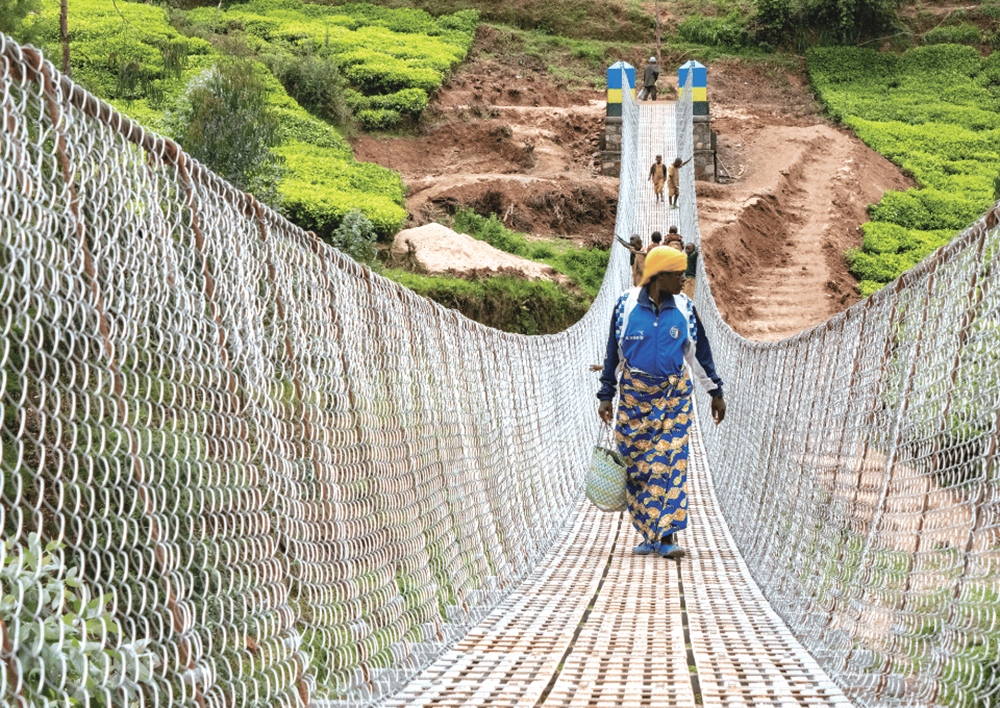
Further to compliance-related consulting performed by the HDGASA, one project epitomised the ideal scenario in which humanitarian aid, technical assistance, and a positive commercial outcome all came together. This was the Association’s interaction with an American NGO that was trying to address extremely hazardous river crossings in remote villages in Africa. “Wooden structures were temporary as their service lives were limited, and no effective maintenance programmes were available to ensure safety. We discussed the viability of steel bridges and options related to corrosion control systems required for extended service life, subject to low-maintenance scenarios. A further goal was to create upskilling opportunities for those building the bridges,” he recalls.
The NGO, aptly named ‘Bridges to Prosperity’, was able to meet its objectives through the supply of the required rib and plate components. “The above example demonstrates that the HDGASA is well positioned to play a vital ‘bridging’ role when it comes to the promotion of hot dip galvanising and the application of the required standards and test methods across Africa,” Clarke concludes.






© Technews Publishing (Pty) Ltd | All Rights Reserved
 printer friendly version