



Five tons of thrust
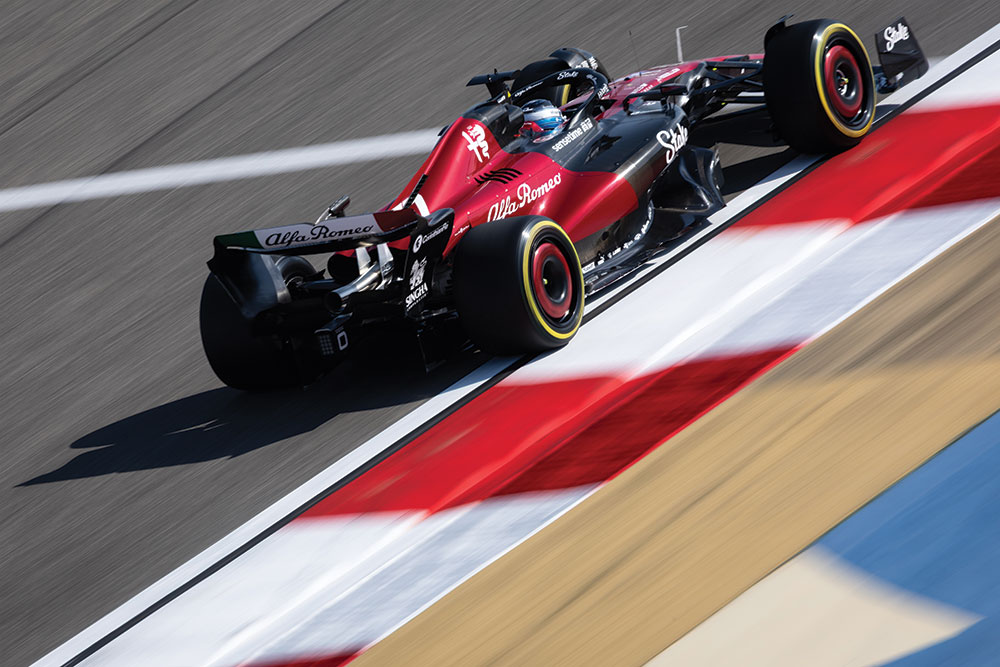
Anyone wanting to take part in Formula 1 works practically non-stop on improving the car and on finding the best possible setup for the next race. From 2026, Sauber will be the Audi works team and compete in the F1 championship. At present, the Swiss motorsport experts are part of the Alfa Romeo F1 Team Stake. To fine tune the best possible aerodynamics setup, they have their own wind tunnel in Hinwil, not far from Zürich.
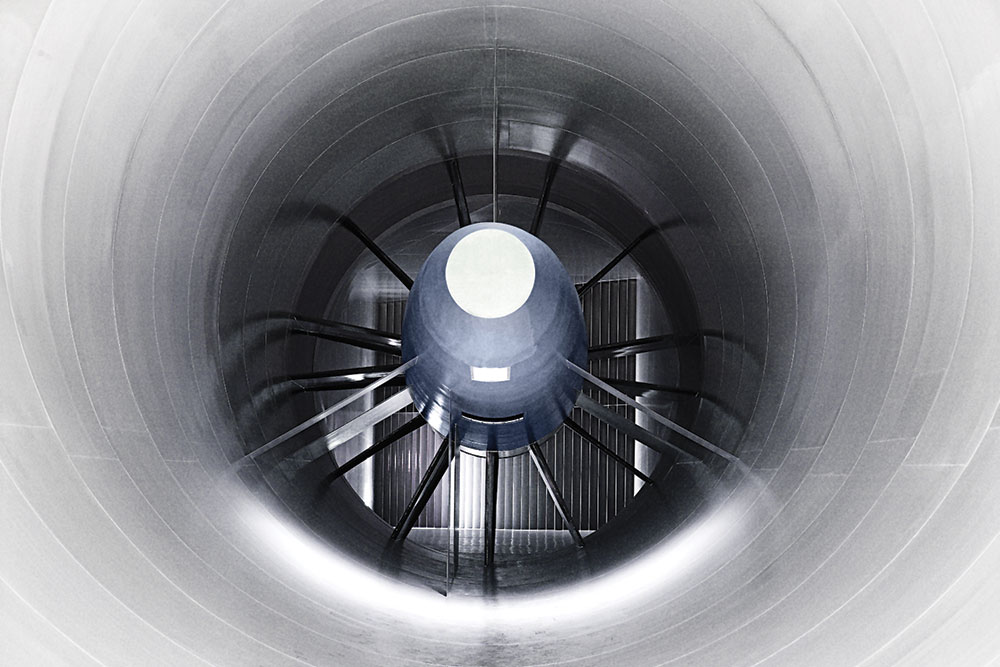
The steel-built facility is a closed loop measuring 140 metres in length. Inside, a 3000-kilowatt turbine generates a thrust of up to five tons. This artificial wind is transformed into a uniform airflow by rectifier elements, in the form of grids and honeycombs, and guided into the test chamber. There it pushes against the outer skin of the model car, simulating the drag that occurs under actual race conditions. “According to the rules, we are not allowed to test the race car itself,” explains Peter Herrsche, who manages the Sauber Group’s wind tunnel. “However, using a model also has significant advantages, because it allows us to work much more flexibly and efficiently. Unlike the actual car, the model also has enough space inside for the measuring instruments that we need to obtain detailed information from the tests.”
The model car is 60% the size of the original, and is roughly three metres long. In the wind tunnel, it stands, or rather ‘moves’, on a ‘rolling road’. This is a moving belt with imitated racetrack surface, which is incredibly expensive, and can be operated up to 300 km/h. Sophisticated attachment to a movement system ensures that the model can simulate all active manoeuvres that a car performs on the track, from acceleration and braking to cornering and drifting. The turbine delivers the headwind corresponding to the speed of the rolling road. An aerodynamically generated downforce acts on the tyres. The drag affects the car as it would in a real race, for example in a completely different way when cornering than on long straights.
“The DRS may be used on only a few sections of the racetrack,” explains Herrsche. “However, this wing position can make a difference of up to 25 km/h when overtaking.” Changing the angle of the top scoop on the rear wing reduces drag. The complicated Formula 1 rules permit this only at precisely defined points and when the distance to the car ahead is not more than one second.
Regardless of whether overtaking is successful or not, the wing folds back down immediately after the incredibly fast manoeuvre has been completed, and drag and downforce increase again. The perfect balance between these two variables is different for each racetrack. The aerodynamics specialist continues, “On the extremely fast Monza circuit, for example, we want drag to be as low as possible, but on the narrow streets of Monte Carlo we need lots of downforce.”
Measuring instruments plus buttmeter
Up to 350 measuring points, in the form of dynamic pressure probes, record the pressure distribution over the surface of the model. The forces that occur at the tyres, front wing and rear wing are measured using special scales. In a test sequence lasting 15 to 20 minutes, up to 70 items such as the wing position or the behaviour of the underbody are tested. Variables such as full and empty fuel tank or new and worn tyres are also simulated.
Furthermore, the aerodynamics engineers constantly exchange information with the racing team during the training sessions on the racetracks. Although the driver’s own ‘buttmeter’ doesn’t deliver any accurate data, it does provide indispensable information to help find the optimum setup. “The driver is the one in the hot seat, so ultimately the car needs to function in the way that is best for him,” emphasises the wind tunnel manager. “His feedback is therefore also a very important variable for us.”
The objective is always the lowest possible drag, with as even a downforce distribution as possible, during all driving manoeuvres and in all imaginable situations. “You have to imagine the car itself as a set of scales,” says Herrsche, describing one of the particular challenges of testing. “When braking, the nose drops and the effect of drag changes accordingly. At the same time, the underside of the vehicle – on a racecar this is always very close to the ground, and on the model the distance is another 40% less – must not come into contact with the rolling road. At the defined test speed, this would cause enormous damage to the model and the moving belt. We have to be able to dynamically control this pitching motion of the model precisely to half a millimetre.”
No time for technical problems
This means, for example, adjustment of the wings has to be accurate to within one tenth of a millimetre. This is where the motors from Faulhaber come into play. A total of eight drives are used in a test run. Six of them move the attachment and control elements, and two are responsible for the wing angles. Where space in the model is particularly limited, the brushless DC-motors of the 1226…B series are implemented. Where more room is available, the larger 2264…BP4 model with the MCBL3002 motion controller is used.
These drives deliver the necessary torque from the smallest possible volume, and can be installed even in constrained spaces. To adjust the attachment of the model to the wind tunnel ceiling, Sauber uses the most powerful brushless motor from the FAULHABER product range: the 4490…B model, also with a motion controller, in this case from the MCBL3006 series.
The precision of the drives is at the top of Sauber’s list of requirements. However, this is followed closely by durability and reliability. Herrsche says, “On the one hand, the rules limit the duration of the test runs in the wind tunnel. At the same time, in the Formula 1 season, the next race that we need to prepare the car for is always just around the corner. We can’t waste a minute, and the technology used simply has to be 100% reliable. The motors from Faulhaber have helped make sure of this for many years, and we are extremely pleased with them.”
| Tel: | +27 76 563 2084 |
| Email: | [email protected] |
| www: | www.hornet.cc |
| Articles: | More information and articles about Horne Technologies |






© Technews Publishing (Pty) Ltd | All Rights Reserved
 printer friendly version