


IT in Manufacturing


Accelerating digitalisation across process industries

August 2024 IT in Manufacturing

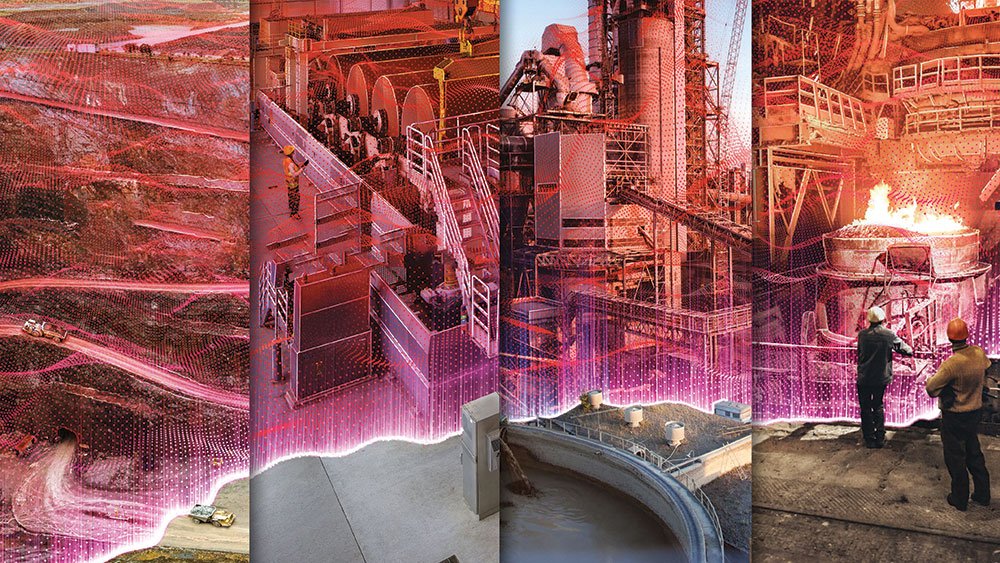
ABB has launched Do More With Digital, a global campaign highlighting the opportunities for the process industries to realise their full potential through digital transformation. Leveraging its deep ties across industries such as pulp and paper, mining, metals and cement, ABB recognises a significant opportunity to continue equipping these sectors with advanced industry-specific solutions. This will drive their digitalisation journey, and allow them to accelerate their adoption curve in a shorter timeframe.

While these industries will continue to be enhanced through technology development using the likes of generative artificial intelligence (Gen AI), data analytics, machine learning (ML), and cloud and edge computing, they are also considered hard-to-abate because of the volume of production, the location of operations, the energy and heat chemistry, and many other factors. The World Economic Forum reports that digital solutions can accelerate net zero in high-emission industries, delivering up to 20% of the total reduction that the International Energy Agency says is needed by 2050. ABB is leveraging its experience of previous energy transitions, its recent record in industrial software development, and its 140 years of experience across multiple industries to guide customers on their digitalisation journeys.

ABB has worked with customers across the process industries for decades, supporting them with the deployment of digital solutions such as advanced process control (APC), energy management systems (EMS), and manufacturing execution systems (MES). These have evolved from original packages to become variations used for distinct industries, with their own tools and libraries. They remain the foundation for advanced technology progression. Customers recognise that they are at different stages of their digitalisation journey. These can be with starters (those embedding digital for the first time), stallers (those piloting a new advanced solution, often with a startup), or scalers (those moving to the next level, perhaps with a technology company). ABB is currently working across this ecosystem to design and develop new solutions for current and future needs.

“Adoption of advanced digital technologies is still much slower than one might expect in the process industries,” said Sanjit Shewale, global business line manager for ABB Process Industries. “Customers are facing new challenges in proving and scaling up solutions that will drive real, transformative change. However, there are opportunities for all parties to use technologies to retain knowledge of processes in their business as people retire or move on in shorter timeframes than was typical in the past. Through co-creation, there is the chance to show more and do more for positive investment decisions that quickly result in unprecedented levels of energy management, efficiency, sustainability, safety and service.”

ABB is currently working with fellow global technology companies to integrate the likes of Gen AI capabilities into the ABB Ability suite of industrial software, supporting industrial companies to improve data collection, unlock insights hidden in operational data, and enable significant gains in efficiency and productivity. Partnerships also exist for initiatives to accelerate the adoption of digital solutions to help industries meet their goals on net-zero emissions. One such example is real-time data transmission using cloud-based software integrated with ABB systems.

ABB’s team embraces what it refers to as five key pillars – operational excellence, process performance, asset performance, sustainability, and connected workforce, all with embedded cybersecurity. ABB considers such a framework when advising industries that need to keep up the rapid pace of innovation, optimise efficiency, minimise energy waste and reduce costs.


Credit(s)


Share this article:
Share via emailShare via LinkedInPrint this page

Further reading:

Even in autonomous systems, human insight is important
Schneider Electric South Africa IT in Manufacturing
As AI, IIoT and digital twins reshape industrial operations, Schneider Electric’s Kobus Vermeulen and Bafana Msibi argue that the operator’s role is shifting from controlling equipment to interpreting intelligence, validating AI recommendations and making decisions that improve

Read more...
AI-based quality inspection scales across P&G operations
Siemens South Africa IT in Manufacturing
Siemens and Procter & Gamble are expanding an AI-based visual inspection system across P&G’s manufacturing operations worldwide, inspecting products in real time at full line speed, and reducing scrap rates by 10 to 20% depending on the product.

Read more...
How sustainability unlocks real business impact
Rockwell Automation IT in Manufacturing
Sustainability has moved from a compliance obligation to a strategic driver of resilience and value for manufacturers. Rockwell Automation explains how its Triple A framework and connected-data approach help producers cut energy, water and waste while improving productivity.

Read more...
Mining’s AI future will depend on people as well as technology
IT in Manufacturing
South Africa’s mining industry is embracing digitalisation and AI, but AvenirHoldings chief executive officer, Tshidi Mndzebele says the real test is whether the people behind the industry are equipped to move forward with it, and outlines five things mining needs to get right.

Read more...
How BIC overcame operational silos to integrate technology and people
Rockwell Automation IT in Manufacturing
Manufacturing giant BIC deployed Plex MES from Rockwell Automation at its Bizerte plant in Tunisia, replacing fragmented, partly in-house software with a single cloud-based execution system that broke operational silos and improved shop-floor visibility.

Read more...
AI in industry is an early warning system, not a guarantee
Schneider Electric South Africa IT in Manufacturing
Schneider Electric’s Paul Steyn argues that AI in industrial maintenance is only as good as the infrastructure and people behind it, and explains the three layers a facility needs before predictive maintenance can deliver on its promise.

Read more...
SA’s mining industry must put people at the heart of its digital future
IT in Manufacturing
South Africa’s mining industry employs around 470 000 people while its digital transition accelerates. Avenir’s chief executive officer, Tshidi Mndzebele argues that technology should enable and upskill the workforce rather than replace it, setting out five ways mining can make technology work for its people.

Read more...
Quality control supports efficient tissue production
Valmet South Africa IT in Manufacturing
Valmet’s advanced quality control technology is helping tissue producers improve product consistency while reducing energy and raw material consumption. Its latest installation at KORO Paper in Vietnam combines real-time measurement, process optimisation and non-contact, nuclear-free quality control.

Read more...
Patented algorithm maximises operator efficiency
Rockwell Automation IT in Manufacturing
Rockwell Automation piloted a patented anomaly detection algorithm and FactoryTalk DataMosaix at its Twinsburg electronics plant, giving operators 30 to 60 days’ advance warning of stencil failure, improving fail rates by 22% and achieving a 200% return on investment.

Read more...
Cybersecurity must become part of the next era of industrial automation
Adroit Technologies IT in Manufacturing
The EU’s Cyber Resilience Act is setting a global benchmark for connected products, making cybersecurity a core engineering requirement in industrial automation. Adroit Technologies and Mitsubishi Electric explain how building security into controllers, PLCs and drives from the outset helps South African manufacturers protect production and meet international expectations.

Read more...


While every effort has been made to ensure the accuracy of the information contained herein, the publisher and its agents cannot be held responsible for any errors contained, or any loss incurred as a result. Articles published do not necessarily reflect the views of the publishers. The editor reserves the right to alter or cut copy. Articles submitted are deemed to have been cleared for publication. Advertisements and company contact details are published as provided by the advertiser. Technews Publishing (Pty) Ltd cannot be held responsible for the accuracy or veracity of supplied material.


© Technews Publishing (Pty) Ltd | All Rights Reserved

