



In South Africa, industry is at an energy crossroads, caught between optimising energy usage to contain costs, and reducing carbon footprints in line with global sustainability and compliance legislation, and in line with global parent companies’ best practice standards. Dennis Williams is the commercial director at Associated Energy Services (AES), a specialist operations and maintenance service provider to the steam and boiler sector.
He observes that this is a big ask for local industrial and manufacturing companies grappling with an uncertain energy situation and a challenging economy. “It is a juggling act to emulate the rest of the world in reducing carbon emissions, while still needing
The green versus greener debate
The first hurdle is the green versus greener energy debate. This involves green energy usage focusing on options which entail a switch to an alternative, renewable fuel or energy source versus greener options, involving optimising energy efficiency to achieve a reduced environmental impact, while using a non-renewable fuel or energy source.

“AES addresses the generation and supply of steam from coal, liquid fuels, biomass and biogas, allowing our clients to optimise efficiencies and futureproof their plants. For those who are pondering the issue of green energy versus energy efficiency, we can offer input, guidance and solutions. Companies using coal can consider converting to natural gas, which despite still being a fossil fuel has a smaller carbon footprint. Alternatively we can help our clients to use less coal on their plants to generate the same energy through optimising their production processes and combusting more efficiently,” Williams explains. “We look for opportunities to diversify our clients’ fuel mix, and for them to optimise their energy efficiency, reduce their risk, and minimise the total cost of production throughout the operational life of their plants. This does not have to be at the expense of greener energy options.”


Powerful energy insights
AES works with clients to realise ongoing improvements. This involves energy plant assessments to provide the insights required to make any necessary adjustments and ensure all is working correctly. From the outset, AES engages clients regarding precisely what equipment is on site, and how their steam process operates, processing data from their systems or employing equipment to capture data to fill in the gaps.
“We want to know what their process looks like, how much energy they use, how they use it, and when they use it. Some companies have a very flat profile (such as a tissue manufacturer) where there is a very consistent offtake, while others have a batch-driven process (such as a tyre or a food manufacturer) with peaks and troughs. “Many businesses see steam use as a linear process, and do not appreciate that product type and mix have a big impact,” says Brenainn Cross, AES technical director.
With this information, AES identifies any energy blind spots and the low-hanging fruit that can deliver immediate energy savings. There are countless examples of how clients that insulated heated surfaces rapidly recovered wasted energy. “Uninsulated steam lines result in energy losses through radiation heat transfer. For a steam line with the specific parameters stated, insulating this piping would amount to a reduction in CO2 emissions of 620 tons per annum,” Cross says.
Fuel selection is also important. Poorly selected fuels can clog boiler tubes, leading to breakdowns and downtime, and can have a long-term effect on other mission-critical plant components such as combustion systems.
Managing change
Ultimately, AES must assess whether a client’s thermal energy plant is fit for purpose. At the same time, clients need to be realistic, and not underestimate or misunderstand their own energy requirements. With a large thermal energy demand, use of onsite traditional renewables will simply not suffice, as energy requirements are too large. Alternatively, the potentially constrained supply and cost of certain biofuels may mean these are not the best choice.
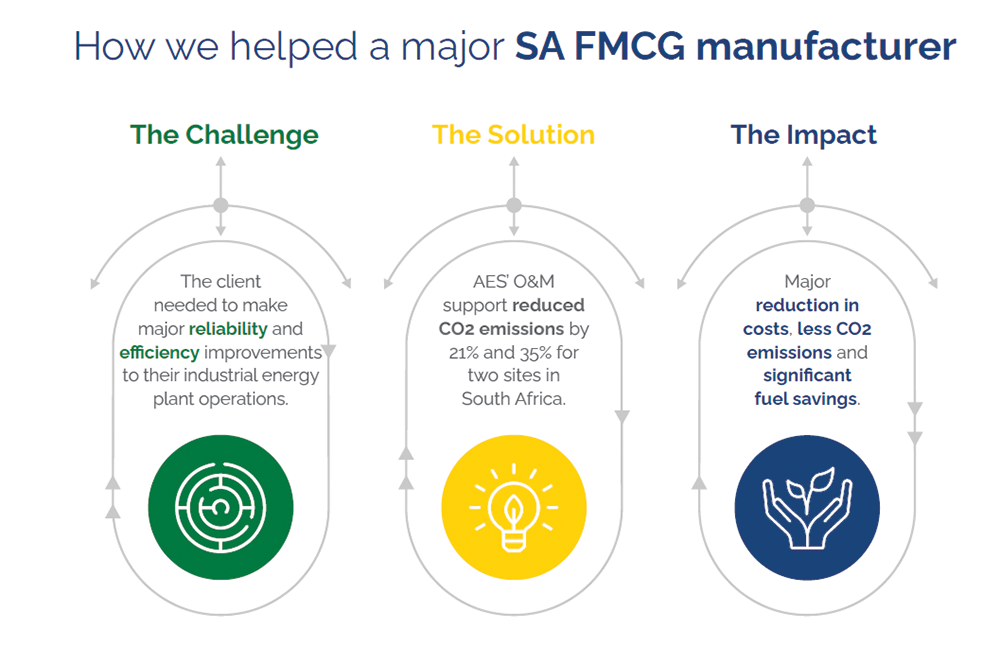
“Over the past three years, we have seen increased pressure from larger clients requiring a more direct solution to environmental or carbon tax concerns. AES has assessed many unusual prospective fuel types, including the use of process byproduct streams. An assessment often proves that the potential energy generation does not warrant the capital expenditure required to make the fuel change,” Cross warns. On the other hand, AES has many client case studies of successful transitions to greener fuel alternatives.
“We are increasingly seeing industrial plants committing to greener energy options that might have cost implications at the outset, but will have a good pay-off later. AES can assist local plants to optimise and also green their thermal energy, despite the challenges,” Williams concludes.






© Technews Publishing (Pty) Ltd | All Rights Reserved
 printer friendly version