



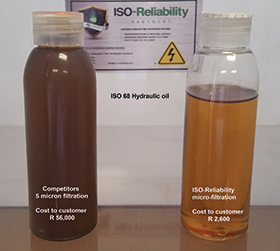
The path to contamination-free fuels relies on a combined effort from refiners to transporters, storage depots, handlers and end users, all playing a role in minimising contamination. Prior to use, fuels can be polished with multi-pass microfine filtration systems such as those exclusively manufactured by ISO-Reliability Partners. Its microfine filtration systems include a stainless steel desiccant air breather that provides moisture absorption, together with radial and depth filtration, with around 6000 times the filtration media when compared to market competitors. The breather is filled with thousands of desiccant silica gel beads designed to absorb moisture from the air and tank headspace. These change colour when filters need to be serviced. The breathers are fitted on diesel and oil bulk holding tanks, gearboxes, and lube and hydraulic systems to capture large volumes of moisture and particulate contamination at low cost.
“This makes the technology not only feasible, but also highly recommended in comparison to common options on the market,” says Craig FitzGerald from ISO-Reliability Partners. FitzGerald’s knowledge around fluid cleanliness spans 25 years, leading to the development of highly effective methods of exclusion and removal of all forms of hydrocarbon contaminants plaguing today’s high power, high precision industrial equipment.
While most fuel filters recommended by engine manufacturers have a nominal pore size of ten microns, studies reveal that the critical particle size for initiating significant abrasive wear in rotary injection fuel pumps and in high-pressure fuel injection systems ranges between one and seven microns. However, as designs to reduce emissions result in higher rail and injector pressures, the tighter clearances have less tolerance for solids, moisture, and impurities in the fuel. As a result, some engine manufacturers now specify filters with pore size as low as two microns. “The problem is that moisture and dust particles that can pass through a two micron filter can easily damage the injection parts of a diesel engine. The present standard is therefore not strict enough,” highlights FitzGerald.
SANS 342:2016 has made strides towards reducing engine failures, with the inclusion of ISO 12156-1 for fuel lubricity, an essential assessment. “It must be noted that testing is done at the refining stage, yet contaminants continue to enter well after the fuel is given the greenlight for quality,” notes FitzGerald.
Traditionally, removing contaminants is an expensive and arduous task. It cannot be fixed by filtering the fuel through in-line filters only. After refining, fuel passes through numerous tankers, trucks, and storage vessels before it reaches the end user. Thus, there are many potential sources of unwanted contamination. Older fuel tanks, particularly those made from black iron, are highly susceptible to internal rust and corrosion. Thus, previously clean fuel could become contaminated in a tank with internal rust build-up. During transportation, constant vibration and sloshing could detach particulates.
“Air breathers throughout industry are insufficient,” warns FitzGerald. High volumes of dust and water moisture enter each time fuel is transferred, further exacerbating the problem. Water moisture in diesel fuel is one of the most troubling types of contaminants, and also one of the toughest to combat in large bulk fuel tanks. Since fuel is purchased, transferred, stored, and utilised out of sight, contamination and water buildup are difficult to detect, unless they are regularly and properly tested for. Water can enter the fuel in a number of different ways. Diesel fuel is hygroscopic, meaning it absorbs moisture from the air. This is an issue for oil and fuel holding tanks not fitted with fine particulate and desiccant filtration.
ISO-Reliability Partners is an own emblem manufacturer (OEM) of class-leading microfine oil filtration solutions, vacuum dehydration systems, automated water removal for compressed air, and high-efficiency industrial air scrubbing. Its expertise combines the sciences of lubrication, filtration and tribology. It has the capability to analyse in-operation oil samples and implement proactive measures to counter machine wear as part of predictive maintenance. “We offer unique and dramatic cost-reduction solutions for our customers,” concludesFitzGerald.






© Technews Publishing (Pty) Ltd | All Rights Reserved
 printer friendly version