Five reasons to use energy chains
September 2023
Electrical Power & Protection
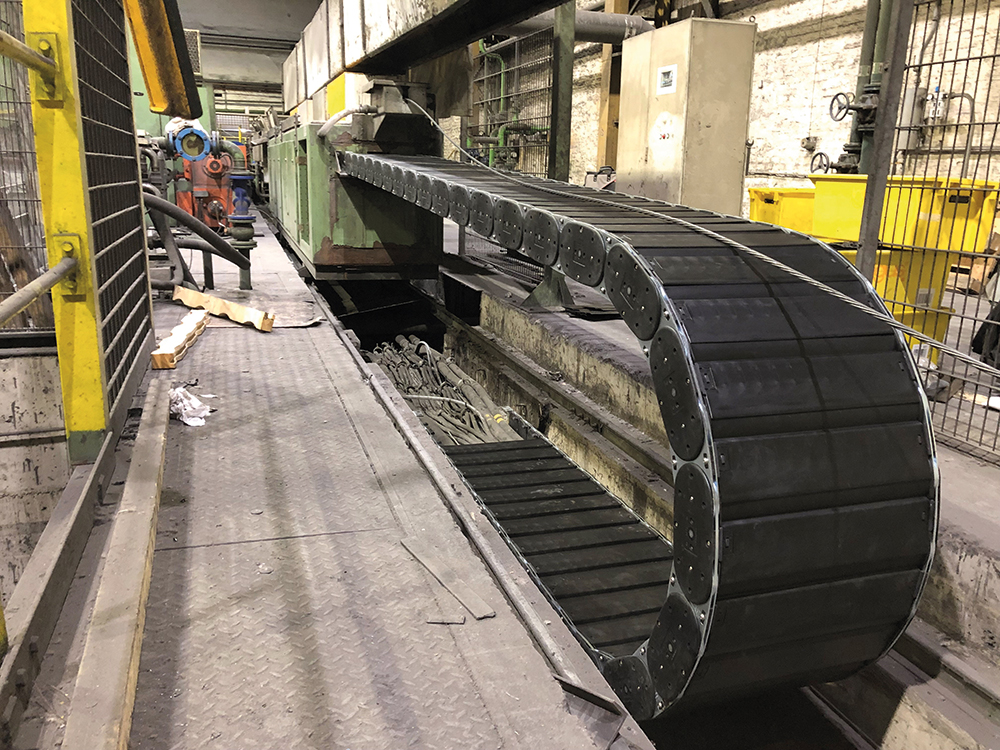
Polymer energy chains provide improved low-maintenance protection for cables, hoses and pneumatics in industrial equipment wherever power, data, control, fibre and optic cables are required.
Global polymer manufacturer, igus is steadily making inroads into cable management on machines where repetitive linear movements are required. The energy chains usually replace festoon systems on equipment like gantry cranes and tripper cars, and can even replace cable reel drums on heavy-duty mining machines such as stackers and reclaimers.
igus managing director, Ian Hewat, says its e-chain cable carriers are increasingly being designed into new systems or retrofitted in festoons and cable reel systems in many industries. Rather than looping cables or winding them onto a drum, the e-chains simply act as a moving conduit or a sort of spine that keeps the cable neat and always protected.
These are the five reasons to choose igus energy chains over festoons:
1. Increased reliability: igus energy chains are designed to provide reliable performance, which reduces downtime through protecting the minimum bending radius. Unlike festoons, which can be prone to snagging and wear, energy chains offer a more robust and controlled cable management solution. Among these solutions are their chainflex cable that is specially designed to run inside the e-chains.
2. Reduced maintenance: Energy chains require minimal maintenance compared to festoon systems. igus energy chains have a self-lubricating polymer, reducing the need for constant maintenance, whereas rollers on festoons need regular lubrication. The e-chain also allows you to add cables and hoses should you wish to do so.
3. Better cable protection: Through the design of the energy chains, the minimum bending radius that shields cables and hoses is controlled, which reduces the risk of damage or electrical failures caused by external elements. Festoons, on the other hand, have their radius exposed and uncontrolled, with added stress and tension on the hanging parts.
4. Space efficiency: igus energy chains are designed to be compact and space-efficient, making them suitable for applications with limited space, whereas with festoons you need to allow space for the cables depending on the length of travel and number of trolleys used.
5. Safety: Energy chains contribute to a safer work environment by preventing cables from hanging loose. The e-chain can be installed at a lower level due to its compactness, making any sort of maintenance easier and safer. Festoons need to be at a much higher level, impacting health and safety.
Effective cable management systems should complement an operations’ objectives and result in better productivity, increased reliability, improved safety and reduced costs. Polymer energy chains from igus tick all these boxes and more.
Further reading:
High-performance industrial power converters
Electrical Power & Protection
Vepac Electronics supplies PowerGood’s range of industrial AC/DC and DC/DC converters, spanning 15 W to 700 W, with full protection features and compliance with EN55032 Class A and Class B electromagnetic interference standards.
Read more...
Decarbonising the energies and chemical industry without the risk
Schneider Electric South Africa
Electrical Power & Protection
Schneider Electric argues that decarbonisation in Africa’s energies and chemical industry need not compromise production or profitability. A phased, digitally enabled approach, starting with energy efficiency improvements, can reduce emissions while strengthening competitiveness.
Read more...
Modular UPS system with scalable, high-availability architecture
Electrical Power & Protection
Legrand South Africa has launched its fifth-generation TriMOD three-phase modular UPS, available from 10 to 80 kW. The system features hot-swappable modules, multiple input/output configurations, and up to 99% efficiency in Eco Mode, designed for data centres and critical industrial environments.
Read more...
Accurate illuminance measurement for safer, more efficient environments
Electrical Power & Protection
The Sonel LXP-10A illuminance meter is designed for accurate measurement of lighting levels in industrial environments where adequate illumination is essential.
Read more...
Why mining operations need local lightning early warning
Senseca
Editor's Choice Electrical Power & Protection
Lightning can develop into a serious mining hazard before the first local strike, leaving crews little time to stop work and reach safety. Local early-warning technology can provide valuable lead time, allowing mines to connect developing storm conditions to defined trigger actions that protect people, explosives and equipment.
Read more...
South Africa’s dirtiest fuel is building its most resilient boilers
Electrical Power & Protection
Steinmüller Africa argues that duff coal, the low-grade fines and discards stockpiled over decades, can now underpin reliable, compliant industrial boilers using mature circulating fluidised bed combustion technology, turning a long-standing liability into a phased energy transition pathway.
Read more...
Retrofitting for sustainability
Schneider Electric South Africa
Electrical Power & Protection
As budgets tighten and sustainability targets increase, retrofit and modernisation strategies are gaining traction across Africa, allowing organisations to upgrade only what limits performance while preserving existing infrastructure and extending asset life.
Read more...
USB-Datalogger for voltage 0 to 30 V DC
Vepac Electronics
Electrical Power & Protection
The PeakTech 5186 is a data logger for DC voltages from 0 V to 30 V with terminals on the top of the device.
Read more...
Pole-top boxes for smarter, more secure electricity networks
Electrical Power & Protection
As South Africa accelerates the rollout of smart prepaid electricity metering, innovative enclosure technology from Power Process Systems is helping utilities improve network security, reduce electricity theft and protect critical electrical infrastructure.
Read more...
Simplifying electrical design compliance
Electrical Power & Protection
Referro Systems highlights how Rockwell Automation’s Global SCCR Tool simplifies short-circuit current rating compliance for complex industrial electrical systems.
Read more...










 printer friendly version