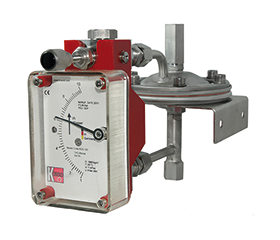
Whether for gases or liquids, Kobold’s KDS flowmeter performs process monitoring and control tasks reliably. Via a magnetic tracking system, the float position is transmitted to a corresponding pointer and optionally to an analog output.
The fluid flows from bottom to top through the meter tube of the flowmeter. The float is lifted until an annular gap between the measuring cone and the float is produced, which corresponds to the flow. The forces acting on the float are in equilibrium. The height of the float resulting from the flow rate is transmitted by the permanent magnet in the float, through the magnetic tracking system in a rotation to the pointer axis of the analog indicator unit.
The variable-area flowmeter comprises a stainless steel device with an integrated, conical stainless steel measuring tube and a vertically movable float. The KDS-K/C model has a built-in valve for setting the flow rate.
The robust Kobold KDS flowmeter, with its low wear rate, is widely used in the chemical industry as well as in medical and laboratory engineering. It is used for measuring mass and volume flow rates or for dosing applications, and is available with additional electrical equipment for process monitoring and control. The KDS meter is also suitable for flow measurement of liquid or gaseous products in pipes. It shows the current flow rate in volume or mass per unit of time.
Characteristics include:
• Measuring range for water: 0,1-1 l/h to 20-200 l/h.
• Measuring range for air: 3-30 Nl/h to 600-6000 Nl/h.
• Accuracy: +3,0% of full scale.
• Pressure maximum: 420 bar, temperature maximum: 130°C.
• Optional analog output contacts, flow controller, high-pressure application.
• Horizontal and vertical connections and wall mounting variations are available.
Hygienic and accurate flow measurement ifm - South Africa
Flow Measurement & Control
ifm’s ultrasonic sensor detects flows of conductive and non-conductive media with high precision.
Read more...Hygienic ultrasonic flow sensor ifm - South Africa
Flow Measurement & Control
The SU Puresonic Hygienic ultrasonic sensor from ifm detects flows of conductive and non-conductive media with high precision.
Read more...VEGA pressure instrumentation supports resilient water network management VEGA Controls SA
Pressure Measurement & Control Flow Measurement & Control
As rapid urbanisation and climate pressures strain water networks across Africa, accurate real-time pressure monitoring has become a strategic necessity. VEGA’s pressure instrumentation helps utilities reduce losses, protect infrastructure and meet sustainability targets.
Read more...Field calibration made easy Instrotech
Maintenance, Test & Measurement, Calibration
Instrotech’s locally designed and manufactured Calog calibrator range feature a rugged IP54-rated housing, backlit display with data logging via SD card, and a lithium-ion battery with approximately eight hours of run time.
Read more...Groundwater level measurement using LoRa module Instrotech
Level Measurement & Control
Monitoring groundwater levels across large industrial sites is critical. Salzgitter Digital Solution was tasked with developing a fully automated and digital monitoring system using Long Range Wide Area Network technology.
Read more...Flow imaging microscopy for the early detection of harmful algal blooms Yokogawa South Africa
Flow Measurement & Control
Yokogawa’s advanced flow imaging microscopy technology, FlowCam is helping utilities move from reactive treatment to proactive prevention of harmful algal blooms in reservoirs, dams and freshwater sources.
Read more...Never waste a drop
Flow Measurement & Control
Manufacturers of pumps, valves and related equipment have an important role to play when systems for water are being designed or upgraded and should be included at every stage of a project to ensure that the work is carried out within the equipment’s capabilities.
Read more...Infrared solutions for glass manufacturing challenges Instrotech
Temperature Measurement
In the glass industry, infrared temperature monitoring is crucial for maintaining product quality and process efficiency. Instrotech has infrared sensors and cameras which provide non-contact temperature measurements, making them ideal for these high-temperature environments.
Read more...Ultrasonic flow meters ifm - South Africa
Flow Measurement & Control
The ultrasonic flow meter of the SU series from ifm - South Africa monitors liquid media such as water, glycol solutions or industrial oils. It detects the three process categories volumetric flow quantity, consumed quantity and medium temperature.
While every effort has been made to ensure the accuracy of the information contained herein, the publisher and its agents cannot be held responsible for any errors contained, or any loss incurred as a result. Articles published do not necessarily reflect the views of the publishers. The editor reserves the right to alter or cut copy. Articles submitted are deemed to have been cleared for publication. Advertisements and company contact details are published as provided by the advertiser. Technews Publishing (Pty) Ltd cannot be held responsible for the accuracy or veracity of supplied material.










 printer friendly version