



Continuous optimisation and increasingly automated processes are shaping the history of process automation, as well as that of industrialisation. This driving force of progress has led to new measuring principles as shown by the evolution of the vibrating fork concept, also called vibronics, but even this is now subject to digital transformation. Ultimately, the purpose of it all is to make work easier for people and to give us humans the freedom to do what sets us apart – use our brainpower.
Why are field device manufacturers continually developing new technologies? On the one hand, these technologies make work outside in the field easier. Fewer qualified personnel are needed and the technologies boost process automation and expand the scope of applications for the measuring devices. This has been true in the past and will continue to be true going forward. The difference is that the speed of change and new product developments is increasing. On the other hand, the users want to pay only for what they actually need. This is why NAMUR, an international user association of automation technology in process industries, drafted its recommendation NE131 to include the expectations for how 80% of conventional application cases should be covered in order to minimise costs. The main idea behind measuring devices is that they should reliably take care of whatever problems users are trying to solve.
All-metal sensor in demand
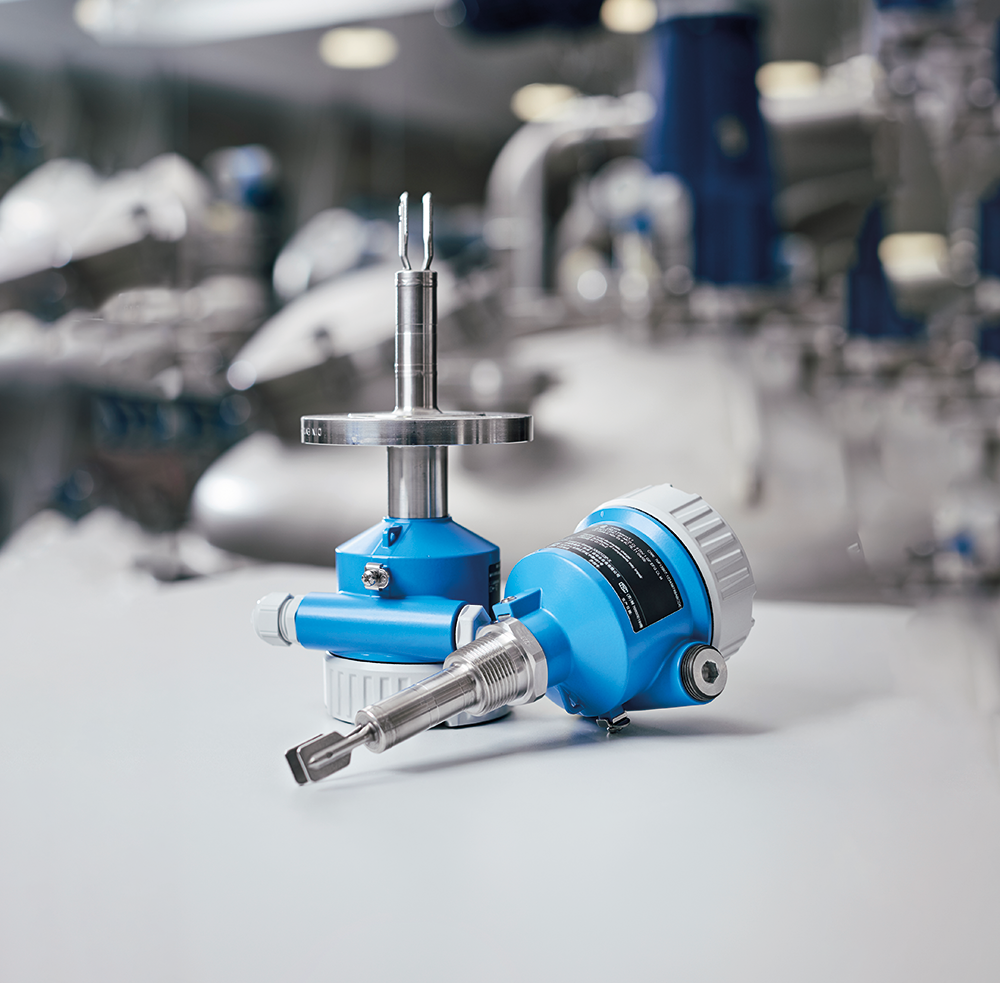
Long before NAMUR released this recommendation, the late 1970s to be precise, Georg H. Endress envisioned the development of a new technology. He wanted to make a sensor that was all metal and thus permanently sealed. The idea was to use one rod in all conventional applications to reliably check whether there was liquid present in a tank or container. When his developers received these specifications, they had their work cut out for them. Capacitive and conductive measuring principles were out of the question because they could not be implemented in an all-metal design. The developers had to think of something completely new. They ended up presenting their boss with a symmetrical dual-rod solution instead of the requested single-rod. A piezoelectric drive causes the two rods, arranged in a fork shape, to vibrate. As soon as there is a medium covering the metal fork, the vibration frequency changes and the sensor generates an output signal.
At first, Endress was disappointed to hear that the single-rod solution could not be implemented. Nevertheless, he took his chances on the dual-rod ‘experiment’. Because, in the end, what was most important to him was for the all-metal sensor to become a reality. This innovation increased the range of the technology, as it could then be used in any media. Not to mention that an all-metal sensor is incomparably more durable than plastic materials. A new measuring principle had been born that detected the level limit no matter what the medium involved. They called it vibronics.
In 1983, the measuring instrument with the vibrating fork hit the market. There was a competition among employees to come up with a name for the product. Endress himself selected a name from among the suggestions: Liquiphant. The name is based on the image of an elephant with two tusks in liquid.
Investment in the new technology paid off. During the first year, Endress+Hauser expected to sell 500 units, but in reality, 5000 units were sold. The developers gave the design a quick overhaul to make it easier to produce in line with the standards for a top-seller.
New applications
Today, Endress+Hauser produces 330 000 Liquiphant units each year. The measuring device is being used in more than six million applications worldwide. The success of the device is due to the fact that it provides exactly what users actually need and are willing to pay for in their applications. At the same time, the Liquiphant made life easier for people. In the oil and gas sector, refineries describe the Liquiphant as one of the safest and most reliable measuring instruments that they have in their applications. The device switches in time to prevent overfilling and protects pumps from dry-running.
Compared to float switches, the Liquiphant is quite straightforward to use in plants. Vibronics measuring devices do not require maintenance and have a long service life. The Liquiphant has also been developed in accordance with IEC 61508, which means that it is designed for use in SIL2 and SIL3 applications. In addition, it is corrosion-resistant.
Digital potential
Anyone who is currently preparing their company for the digital age will have to optimise both their information technology and field levels. This requires sensors that can provide the relevant data for initiating process optimisations and efficiency boosts. In the technology roadmap to ‘Process sensors 4.0,’ NAMUR requires opening up a second, mobile way for communication with the sensor. This way has to provide sensor information for preventive maintenance. NAMUR also requires that product information such as manuals or certificates be available in mobile form on-site at all times.
This is where the technological innovations on the Liquiphant FTL51B model come into play. As an added feature, all product and diagnostic information is digitally readable, which eliminates the effort involved in reaching the device in difficult locations. The device displays what state it is in using an LED, or in diagnostics using Heartbeat Technology. The Heartbeat Technology concept also verifies the device and provides all necessary documentation for institutions. Users derive process optimisations from this and find out what needs to be done for preventive maintenance. Recurring testing in accordance with SIL and the German Water Management Act (WHG) is straightforward on the new Liquiphant. Users simply press a button and step through a wizard.
In the end, any technological innovation is judged on more than its potential. It is also evaluated based on the tangible effects it has in making life easier for users and giving them the freedom to further optimise operations. Therein lies the advantage that humans have over machines. We have the common sense to distinguish real added value from gimmicks and let technology take care of all the arduous, error-prone steps.
| Tel: | +27 11 262 8000 |
| Email: | info.za.sc@endress.com |
| www: | www.endress.com |
| Articles: | More information and articles about Endress+Hauser South Africa |






© Technews Publishing (Pty) Ltd | All Rights Reserved
 printer friendly version