



A challenge accelerated by the coronavirus pandemic has seen producers having to juggle between longer term range proliferation centred on consumer demands and range reduction caused by retailers and consumers rapidly changing buying habits. This has resulted in producers having to be even more agile with existing assets.
These assets in the form of single or connected machines must therefore be more flexible than ever, meaning they must be supplied with the right material and packaging at the right time. To reduce storage costs and waste, companies in the industry want to produce only what is needed for shipping. Autonomous mobile robots (AMRs) and collaborative robots (cobots), as well as traditional industrial robots, are being used in more and more factories, replacing conveyor belts or accumulation/buffer stations. The challenge is to create a flexible, continuous production process for customer-specific manufacturing and to minimise costly, rigid and maintenance-intensive conveyor sequences, which usually take considerable space. Companies that break new ground by using innovative technologies not only gain agility but also reduce scrap, contamination risk, waste and losses.
Food and packaging applications
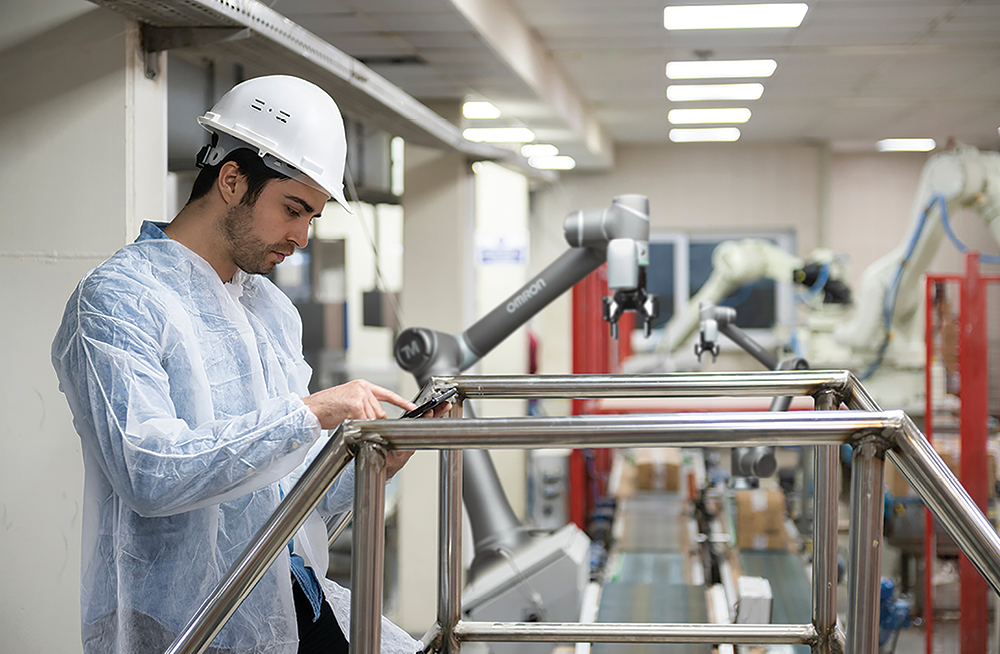
Many companies in the food industry are planning more flexible and seamless production and packaging lines for customer-specific products. This will minimise the need for expensive and inflexible conveyor processes. Easily configurable production lines will ideally consist of collaborative and flexible transport and transfer solutions, tailored to specific production environments. Examples include robots, cobots and more recently, solutions that combine both. Their tasks include the transport of work in progress (WIP) stock between sites or adjacent areas, with the process being managed and controlled by a special fleet management solution. Re-configurable systems in the food industry link assets and reduce costs by storing only what’s needed on the route. Traceability of all stock levels also reduces downtime. At the same time, trip hazards can be decreased and employees supported.
Minimising errors and strengthening traceability
To avoid production downtimes, line side replenishment (LSR) must take place in good time, with a focus on the loading of raw materials, packaging of containers and the dispensing of finished goods. Palletisers play a central role in increasing this latter topic, enhancing productivity, flexibility and traceability of the production process. Innovative robotic solutions help to improve throughput in these areas. Examples are a SCARA (selective compliance assembly robot arm) solution for loading bottles or other containers; robots that load carton and case erectors; and high-speed parallel robot solutions for the orientation and alignment of raw materials and primary/secondary packaged items. Traceability within the process can be ensured via reading and verifying item level and batch level labelling and integrated image processing systems.
Innovative solutions for safe and reliable shipping
The handling and dispatching of goods is also undergoing numerous changes, as retailers want to reduce costs and personnel-related expenses in this area. Food companies face the challenge of picking, placing and sorting incoming products simultaneously. Careful product handling ensures line throughput, reduces waste and prevents damaged goods from entering the downstream process.
Delivering retail-ready solutions and avoiding costly fines and recalls can be complicated. Automation can help to protect the product and improve the OEE of a machine or line, by reducing downtime. At the primary product stage, where fast, accurate, repeatable and efficient handling is required, Delta robots are often the solution. Customised software also enhances flow rates and recipe handling. One controller takes care of all functions (such as motion, vision, safety and robotics).
Product-friendly conveyor control can be achieved by the automatic positioning of the goods on a conveyor. Omron’s Sysmac control platform, for example, features smart conveyor function blocks (FBs) that control the distances and positioning of products, reducing product damage and improving throughput.
Conclusion
The automated flow of goods and optimised loading and unloading of machines will play a central role in the food factory of the future. Companies that want to speed up processes, reduce costs and ease the burden on employees can do so with the help of innovative technology and robotics – and thus take a big step towards competitive strength and sustainability.
| Tel: | +27 11 579 2600 |
| Email: | [email protected] |
| www: | www.industrial.omron.co.za |
| Articles: | More information and articles about Omron Electronics |






© Technews Publishing (Pty) Ltd | All Rights Reserved
 printer friendly version