



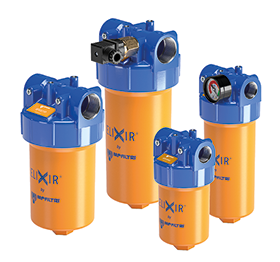
The viscosity of oil in a lubricating system and its impact on bearings if not appropriately filtered, can adversely impact on system performance and even have catastrophic consequences. SKF states: “As long as particles larger than the lubricant film are removed, bearings can have a very long life”. Lubricants must be checked for contamination when the oil is delivered to the plant. Once in use, whether it is offline or online filtration, engineers must ensure the oil remains clean and meets all system specifications.
Chris Banks of Hydrasales advocates contamination control measures and recommends that system designers and integrators incorporate simple, cost-effective equipment to ensure cleanliness in lubrication systems. He cites the inclusion of the following types of equipment for reducing contamination within a hard-working system i.e. applications that normally run 24/7 where operators cannot afford a breakdown or disruption in the working cycle.
A medium pressure inline lubricating oil filter
A wide range of inline filtration options with flows from 200 l/minute to 3000 l/minute, which accommodates pressures from 20-80 bar, is required. Banks elaborates: “Hydrasales has full access to MP Filtri’s filter-sizing software allowing our customers peace of mind that the correct filter is identified for the application, which meets all design requirements.”
These durable inline filters offer a wide range of element media options, including water removal. Banks adds: “They are ideal for high flow charge pump supply lines, a return line, or even offline filtration circuits. The duplex filter range, known as the LMD range, is designed to allow element change during continuous machine operations. This makes maintenance more efficient, eliminating downtime whenever a filter element requires replacement or cleaning. A water removal element is also available with 25 micron effectiveness.”
The following benefits are associated with water removal:
• Dramatically extends oil and hydraulic component life.
• Reduces the chance of catastrophic failure.
• Reduces maintenance costs and associated downtime.
• Increases equipment performance and improves machine productivity.
Check the flow
Lubrication systems deliver precise amounts of lubricant to multiple lubrication points, which require it in the right place and at the right time. However, ensuring reliability in this regard can be challenging.
Banks cites the use of good but cost-effective flow monitoring to ensure that there is sufficient flow at critical points. Hydrasales supplies the Badger meter product range, including Headland variable flow meters available with a micro switch to allow for low flow alarm. An alternative could be visual or electrical oil level gauges to suit the requisite application.
Protect your pump with washable suction filters
MP Filtri’s Elixir range of filters includes the SFEX inline suction filter, including wire mesh filter cartridge for the bowl and housing. This design allows for a mesh element to be easily removed, inspected and cleaned. The more common spin on oil filters cannot be cleaned and need to be replaced. This is not economical compared to a fully re-usable cartridge element.
Suction strainers are generally situated at the bottom of the reservoir and are not easily accessible, especially with a full reservoir. The Elixir range has been designed to accommodate higher flows with an improved connection system to reduce leakage and dirt in the output circuit. The range can accommodate differential clogging indicators and pressures up to 16 bar.
Reservoir breathers for moisture extraction
Studies have shown that around 70% of equipment loss is due to bearing surface degradation. The need for replacement is therefore a direct result of corrosion and mechanical wear. The most common causes of this are dirt and moisture originating outside the machine: when you have moisture in your lubricant, or hydraulic fluid, a myriad of negative influencers can cause problems. For example, moisture leads to corrosion, which in turn leads to particulate contamination. Moisture can also affect the required oil viscosity, deplete additives and result in sludge formation.
Hydrasales offers free support in regard to filter sizing and advice on lubrication system filtration and contamination.
| Tel: | +27 11 392 3736 |
| Email: | [email protected] |
| www: | www.hydrasales.co.za |
| Articles: | More information and articles about Hydrasales |






© Technews Publishing (Pty) Ltd | All Rights Reserved
 printer friendly version