Measuring viscosity made easy
June 2021
Maintenance, Test & Measurement, Calibration
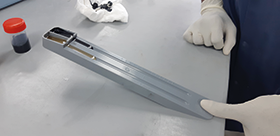
Condition monitoring specialists, WearCheck, recently launched a quick, cost-effective viscosity test kit known as the WearCheck Rheo-stick.
WearCheck technical manager, Steven Lumley, elaborates, “It is important to know the viscosity (thickness) of a lubricant because this determines its film strength and its efficiency in preventing friction between moving parts. Thick oil has a high viscosity and thin oil has a low viscosity.
“The Rheo-stick got its name from the word ‘rheology’, which is a branch of physics that deals with the study of the deformation of matter, such as lubricating oils. The most important rheological property of a lubricant is its viscosity, or a fluid’s resistance to flow. Viscosity is a property of significance as it affects friction and wear between interacting metal surfaces.”
The Rheo-stick is a user-friendly visual viscosity comparator intended to monitor changes in the viscosity of lubricating oils. But, while the Rheo-stick is an effective on-site viscosity comparator, it does not measure the physical viscosity of oil in centistokes and cannot give an indication of the chemical composition of the oil, or identify contaminants or degradation by-products.
Measuring viscosity
To perform the viscosity comparator test users require two clean 5 ml syringes, the Rheo-stick, a sample of the used oil in question, a reference sample of new oil of the same brand/grade and finally, a flat surface on which to work.
Step 1
Take a sample of used oil and allow sufficient time for it to cool down to room temperature. It is essential that both the used and the unused oil sample are at the same temperature.
Step 2
When at room temperature, add 5 ml of used oil to the used oil reservoir on the Rheo-stick by means of a clean syringe. Next add 5 ml of fresh oil to the fresh oil reservoir. The reservoirs must be filled with exactly 5 ml of oil, therefore the use of syringes is highly recommended.
Step 3
Tilt the viscosity comparator until it rests on the angled base at the opposite end from the reservoirs and allow the oil to run down the channels. When the new oil reaches the mid-point on the scale, return the Rheo-stick to the horizontal.
Observe the point reached by the used oil. If the used oil has not reached the scale, then the viscosity is higher than the new oil. A high viscosity could be attributed to oxidation or degradation due to extended oil drain intervals, high operating temperatures, presence of water, presence of other oxidation catalysts, or the addition of an incorrect lubricant.
If the used oil has over run the scale, then the viscosity is lower than the new oil.
A low viscosity could be attributed to degradation of the viscosity index improver (VII) additive in the oil as a result of shear, or due to the use of an incorrect lubricant during refilling and topping-up procedures.
Step 4
After termination of the test, clean the equipment with a suitable degreasing solvent and dry thoroughly with the WearCheck laboratory tissues. Dispose of the waste tissues in accordance with regulatory disposal legislation practices.
Further reading:
Oils don’t die, they degrade
Wearcheck
Maintenance, Test & Measurement, Calibration
WearCheck explores the main ways lubricants degrade in service and how these degradation modes affect oil performance and machine reliability.
Read more...
Real-time spectrum analyser
Vepac Electronics
Maintenance, Test & Measurement, Calibration
The PXE series real-time spectrum analyser covers frequencies up to 20 GHz with a 100 MHz analytical bandwidth and ultra-fast sweep speed, supporting spectrum monitoring, interference finding and RF test and measurement functions.
Read more...
Preserving a French heritage landmark
Omniflex Remote Monitoring Specialists
Maintenance, Test & Measurement, Calibration
Omniflex supplied a remotely monitored impressed current cathodic protection system for the Perret Tower in Grenoble, a protected French heritage site, combining 24/7 corrosion protection with integrated surge protection against lightning strikes.
Read more...
Operational efficiencies and safety compliance with preventive maintenance programmes
Maintenance, Test & Measurement, Calibration
Konecranes explains how its Lifecycle Care Preventive Maintenance programme reduces unexpected downtime, improves safety compliance and delivers measurable financial benefits for operators of cranes and lifting equipment across any make or sector.
Read more...
Portable appliance tester
Vepac Electronics
Maintenance, Test & Measurement, Calibration
Vepac Electronics’ new portable appliance tester enables precise safety testing of electrical appliances in accordance with DGUV regulation 3 and BetrSichV, with simple three-button operation and battery-powered mobility.
Read more...
Why lubrication fails in mining and what to do about it
Maintenance, Test & Measurement, Calibration
Lubrication Engineers explains the recurring failure points behind mining lubrication problems and how the right product, storage and application practices can improve equipment reliability.
Read more...
When digital twins move from concept to critical tool
IT in Manufacturing System Integration & Control Systems Design Maintenance, Test & Measurement, Calibration
Digital twins are moving out of the lab and onto the mine, the factory floor and the transport network where they predict failures before they happen. Amritesh Anand looks at where they earn their keep, the data and integration work behind them, and the security questions every organisation should ask before switching one on.
Read more...
Why asset level intelligence is now essential for resilient wastewater plants
Schneider Electric South Africa
Maintenance, Test & Measurement, Calibration
Sub-Saharan Africa’s wastewater operators face mounting pressure to keep ageing plants running smoothly and meet tougher environmental standards, all while lacking visibility into the health of their medium-voltage (MV) drives and other critical rotating assets. Adding predictive analytics, digital twins and enterprise dashboards enables optimisation across multiple sites, ensuring every drop moves safely and efficiently through the water cycle.
Read more...
How multiple boilers can minimise costly downtime
Maintenance, Test & Measurement, Calibration
Associated Energy Services explains how multi-boiler systems reduce downtime risk for South African manufacturers, covering redundancy planning, fuel source diversification and the strategic management of backup boiler capacity.
Read more...
Field calibration made easy
Instrotech
Maintenance, Test & Measurement, Calibration
Instrotech’s locally designed and manufactured Calog calibrator range feature a rugged IP54-rated housing, backlit display with data logging via SD card, and a lithium-ion battery with approximately eight hours of run time.
Read more...










 printer friendly version