Secure access to field instruments is of the highest priority for operators across all branches of the process industry. Modern plants contain hundreds or thousands of measurement and control instruments that must be accessed remotely with growing frequency. These field instruments also have to be installed, monitored or serviced on a regular basis. Secure password-based user authentication plays a special role today, especially when devices with digital interfaces are involved.
Security with user-friendly password lengths
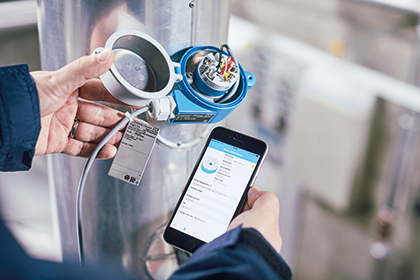
In order to utilise Bluetooth communications technology in industrial environments, security experts at Endress+Hauser identified a need for additional protection. The result was the development of a solution called CPace, which belongs to the class of PAKE (password-authenticated key exchange) methods. Among other things, PAKE technology is used with the German electronic ID cards as a means of largely decoupling the cryptographic security level from the length of the password. The advantage of CPace is that the processing power of even the smallest of field instruments is sufficient to provide devices, and thus the industrial systems, with the best level of protection against cyberattacks. At the same time, CPace enjoys a high degree of acceptance among users given that the desired level of security can be achieved without relying on long passwords.
“We had to look internally to find a solution for establishing secure connections to the instruments,” explains Dr Björn Haase, project head at Endress+Hauser. “Previously available secure methods could not be used because of the limited processing power and storage capacity of field instruments. Password verification would have meant a login delay of two minutes or more.”
CPace makes life difficult for hackers
The security of the PAKE-based solution with Bluetooth technology from Endress+Hauser was previously verified in 2016 as part of an analysis by the Fraunhofer Institute for Applied and Integrated Security. The institute classified the protection level of the Endress+Hauser security layer, the core component of which is recommended for use in Internet environments, as high.
Helping mines get results from water improvements
News
South African mines operate under constrained, water-scarce conditions where every investment must be justified. Xylem’s Chetan Mistry explains how the right water technology partner helps mines prioritise high-value water systems across the mining lifecycle.
Read more...From the editor's desk: Pushing engineering to the limit Technews Publishing
News
Among the many things robots can do, it’s a lot of fun to follow how fast they are. They go from the Boston Dynamics cheetah, which first reached a record-breaking speed of 45,5 km/h, to the robot Charlie ...
Read more...Schneider Electric concludes Innovation Summit Middle East and Africa Schneider Electric South Africa
News
Schneider Electric's Innovation Summit Middle East and Africa, held in Abu Dhabi with more than 2500 attendees, explored the convergence of energy, AI and industrial software, launched an Industrial AI study and announced the NEST Accelerator Programme for energy and industrial tech startups.
Read more...VEGA brings measurement expertise beyond mining to Electra Mining Africa 2026 VEGA Controls SA
News
VEGA used its Electra Mining Africa 2026 stand to demonstrate that its level and pressure measurement instruments extend well beyond mining, covering water, food and beverage, pharmaceuticals, chemicals, and oil and gas applications across the continent.
Read more...Sustainable solutions for sugar Bearing Man Group t/a BMG
News
BMG received a Special Commendation Exhibition Stand Award at the South African Sugar Technologists’ Association Congress, where it showcased an integrated turnkey drive solution designed to simplify the upgrading of ageing crushing-mill drive systems.
Read more...Measure, Manage, Maintain: The operating model behind SA’s water resilience Siemens South Africa
News
South Africa’s growing water crisis is putting pressure on infrastructure, municipalities and the economy. Siemens highlights how digital technologies, smarter operations and safe water reuse could help shift the country from crisis response towards a more resilient and sustainable water future.
Read more...VEGA brings measurement expertise beyond mining to Electra Mining Africa 2026 VEGA Controls SA
News
VEGA used its Electra Mining Africa 2026 stand to demonstrate that its level and pressure measurement instruments extend well beyond mining, covering water, food and beverage, pharmaceuticals, chemicals, and oil and gas applications across the continent.
Read more...Schneider Electric concludes Innovation Summit Middle East and Africa Schneider Electric South Africa
News
Schneider Electric’s Innovation Summit Middle East and Africa, held in Abu Dhabi with more than 2500 attendees, explored the convergence of energy, AI and industrial software, launched an Industrial AI study and announced the NEST Accelerator Programme.
While every effort has been made to ensure the accuracy of the information contained herein, the publisher and its agents cannot be held responsible for any errors contained, or any loss incurred as a result. Articles published do not necessarily reflect the views of the publishers. The editor reserves the right to alter or cut copy. Articles submitted are deemed to have been cleared for publication. Advertisements and company contact details are published as provided by the advertiser. Technews Publishing (Pty) Ltd cannot be held responsible for the accuracy or veracity of supplied material.










 printer friendly version