



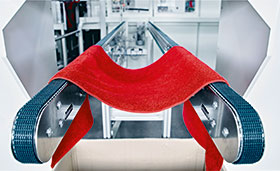
Texpa Maschinenbau in Saal an der Saale, Germany, specializes in transfer sewing lines for home textiles as well as in plaiting machines. To best adapt these machines to the customer's requirements, it makes its systems as modular as possible. The company's new manufacturing system for terrycloth towels signifies the importance of the openness, flexibility and compact design of PC-based control and drive technology from Beckhoff Automation.
Textiles products like bedsheets, pillowcases, drapes and towels are manufactured on a wide range of modular machines. As Heiko Hillenbrand, manager of electronics engineering at Texpa, explains: “Our broad process expertise, consistent equipment modularity and in-house production depth, down to highly complex components like sewing tools, enable us to deliver machines with extremely short lead times. The time from order receipt to delivery can be as short as three months.”
PC-based control enables flexible system configuration
One prime example is the new transfer sewing line for terrycloth towels with its even more streamlined setup changeover capabilities, and the ability to select from various straightening systems with the push of a button. The customer can configure the machine from a modular toolbox based on individual requirements regarding the seam size or a suitable label dispenser, for example. Hillenbrand explains the importance of PC-based control as follows: “The PC and EtherCAT-based control and drive technology from Beckhoff has given us the ability to accommodate a wide range of customer requirements on short notice, because it's the only technology that gives us the necessary flexibility. With conventional hardware PLCs and the corresponding program modules, this would have been impossible to achieve in a financially feasible manner. With TwinCAT software, on the other hand, all we need to do is enable the respective module in the control program.”
The transfer sewing line, which is roughly 12 metres long and 7 metres wide, can produce towels ranging in size from 30 x 30 cm to sauna towels as large as 2 x 2 metres. The machine uses operator input via a visualization system to adjust itself automatically. The maximum output rate for the smallest size is an impressive 1800 towels per hour.
At the start of the process, the continuous terrycloth fabric is fed into a straightening and cutting station. This equipment ensures that the fabric is inserted straight, which is particularly important with terrycloth in order to guarantee a flawless hem. Next, the material is cut to size and transferred to a conveyor. This is followed by up to four tagging stations at which up to eight different tags, strings or hangers can be sewn on. At the subsequent hemming station, the towels are hemmed and transferred to the so-called thread hacker. Hillenbrand explains: “The thread hacker cuts the warp threads. This is where we deployed eXtreme Fast Control (XFC) technology and the distributed clocks in EtherCAT in order to compensate for the latency times that occur when switching the pneumatic valves on the two cutting wheels. In this way, we can achieve much more precision at all transport speeds.”
Christian Rott, CTO of Texpa, adds: “The entire system uses 17 XFC EtherCAT I/O terminals, specifically the EL1252 and EL2262. We benefit especially from the EtherCAT timestamp functionality, with which the signal curves can be coordinated across the system via the distributed clocks function.”
Ultra-compact Industrial PC and OCT drive technology reduce space requirements
Due to the high complexity and extensive modularity of the manufacturing systems, Texpa always pays special attention to the required switching cabinet space. Fortunately, PC-based control offers many opportunities to minimize this space, as Heiko Hillenbrand explains using the new ultra-compact C6030 Industrial PC as an example: “The C6030 delivers great computing power in an extremely compact format. It takes up much less space than the C6640 and C6650 cabinet IPCs we previously used. Another advantage is the fact that it can fit into existing spaces with great flexibility, for example in extremely flat cabinets. Despite its small size, it still features sufficient interfaces for applications such as providing end users with operating data in connection with Industry 4.0 concepts.”
With up to 53 NC axes in a single manufacturing system, the drive technology must be equally compact. With One Cable Technology (OCT), Beckhoff drives require less wiring, produce fewer faults and take up less space because of their smaller power supply chains. Texpa deploys them in smaller processing stations and for the tag handling. Hillenbrand elaborates: “We use both EL7041 stepper motor terminals and EL7221 servomotor terminals, the latter in combination with AM8100 OCT servomotors. This drive technology in terminal block format reduces space requirements further, minimizes power losses and supports the decentralization of drive technology via easy placement of switching cabinets.”
Wireless connectivity and protected power supply
Texpa keeps benefiting from the continuous expansion of the Beckhoff product portfolio in other aspects of its transfer sewing lines as well. The latest example is the CU8210-M001 cabinet dome for industrial WiFi and mobile communication components such as the CU8210-D00x USB 2.0 sticks. With the cabinet dome, which complies with the IP66 standard, a USB port for wireless connections can be fed out of the control cabinet while still being securely protected.
Hillenbrand outlines the user benefits: “We always want to be able to maintain our systems remotely. Normally, we do this over the customer’s Intranet, but this means that we must depend on their network administration. When time is of the essence, for example, when a machine has shut down, access might not be possible if the network configuration has changed. With the new cabinet dome and a machine USB stick, on the other hand, we can always access the system without having to go through the customer's Intranet.”
Texpa will also use the new CU81xx series of uninterruptible power supplies (UPS) in the future, as Hillenbrand conclude: “We prefer the capacitive CU8110 UPS because it does not require maintenance. What’s especially interesting in this context is the UPS-OCT one-cable solution, which employs a single cable for both the power supply and the communication, which makes the wiring easier.”
| Tel: | +27 11 795 2898 |
| Email: | [email protected] |
| www: | www.beckhoff.com |
| Articles: | More information and articles about Beckhoff Automation |






© Technews Publishing (Pty) Ltd | All Rights Reserved
 printer friendly version