IIoT/Industry4.0/4IR – they cover a large area and don’t always mean the same thing. So how do we define any of these terms? Basically, they are about improving manufacturing efficiency, largely through the intelligent use of data. There is a lot of jargon that goes with this, and Lloyd Townsend of WIKA did a good job of unravelling much of it at the last branch technology evening.
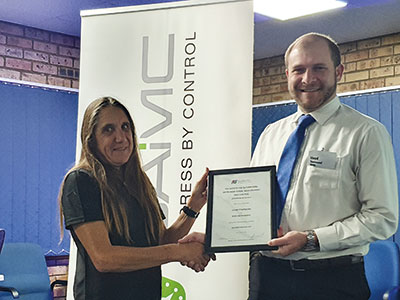
Cheryl Hird thanks Lloyd Townsend after the presentation.
Since it is there, it is tempting to use the cloud for everything, as no investment in hardware is required. However, the drawback is that it can take a relatively significant time to get feedback on the data and hence the emergence of edge computing, where time-critical information is processed right at the application.
Where does the data come from? First of all, a 4-20 mA signal can be used. However, it can only be used once it is in digital form by the control system. Microprocessor-based instruments usually contain much more information than just the process variable, and this can also be used. If the field devices are connected to a bus, whole groups of data can be aggregated, and sent to the cloud in a batch, using a variety of communication protocols. As this data is not usually time-critical, security and accuracy of data is more important than speed. There are a variety of LPWANs (low power WANs) which can do this, one of the more recent being MIOTY. The essence of this is that that the data is broken down into packets, and forward error correction applied. This minimises requests for repeat packets, and, because the data is scattered in small packets, it is difficult for potential hackers to trace.
What about digital twins? As Lloyd explained, system designers generally have a good idea of the desired operation of any system. A virtual – or digital – twin is created, which reacts in the same way the physical system is supposed to, somewhere in the cloud. This can be compared with its real-life counterpart in the cloud, to check whether the desired outcome has been achieved.
Lloyd covered a huge amount in a short period of time, all of it very well presented. The branch thanks WIKA for hosting the evening.
SAIMC: From the office of the CEO SAIMC
SAIMC
The INSPIRE Conference 2026 brought industry and academia together to explore advances in automation, AI, mechatronics and engineering. It also marked a new direction for the SAIMC as it works to build future-ready engineering talent and strengthen South Africa’s automation industry.
Read more...SAIMC Durban takes to the skies SAIMC
SAIMC
SAIMC Durban members went behind the scenes at the ATNS facility at King Shaka International Airport. The visit offered a fascinating look at the sophisticated technology and highly trained people keeping South Africa’s skies safe.
Read more...SAIMC: Durban branch SAIMC
SAIMC
At the SAIMC Durban branch September 2026 technology meeting, Werner Das of SICK explored how deep learning is moving industrial machine vision beyond rule-based systems into practical, everyday quality control on the factory floor.
Read more...SAIMC: From the office of the COO SAIMC
SAIMC
The recognition of mechatronics and computer engineering has created both an opportunity and a responsibility. Recognition means little without participation, professional registration without professional conduct, and technical knowledge without the mentorship, implementation and measurable value that industry needs.
Read more...SAIMC: Johannesburg branch SAIMC
SAIMC
Hendrik Spies of SICK Automation Southern Africa presented at the SAIMC Johannesburg Technology Evening on 12 August 2026, covering the digital journey from condition monitoring to predictive maintenance.
Read more...SAIMC: Durban branch SAIMC
SAIMC
The SAIMC Durban branch hosted S’yabonga Langa, systems performance engineer at eThekwini Electricity, who presented on applying substation automation to improve operational efficiency and service quality in modern power distribution networks.
Read more...SAIMC INSPIRE 2026 brings together industry, robotics and research
SAIMC
The inaugural SAIMC INSPIRE Conference will bring together the industrial automation, robotics and academic communities for two days of presentations, panel discussions and networking, and will explore developments in smart manufacturing, mining, robotics
While every effort has been made to ensure the accuracy of the information contained herein, the publisher and its agents cannot be held responsible for any errors contained, or any loss incurred as a result. Articles published do not necessarily reflect the views of the publishers. The editor reserves the right to alter or cut copy. Articles submitted are deemed to have been cleared for publication. Advertisements and company contact details are published as provided by the advertiser. Technews Publishing (Pty) Ltd cannot be held responsible for the accuracy or veracity of supplied material.










 printer friendly version