



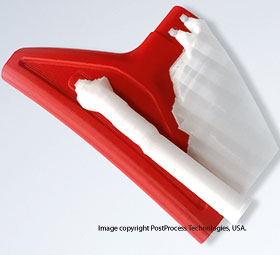
Additive manufacturing processes can produce parts with the most complex geometries in a single operation. However, post-processing these 3D printed parts is time consuming and costly. In order to remove this bottleneck in the pro-duction process, PostProcess Technologies has developed a series of machines that leverage a ground-breaking chemistry of detergents and abrasive media. The newest example is the Hybrid DECI Duo. The multi-functional machine pro-vides automated removal of support material and surface finishing. It was automated with control technology from Beckhoff.
The challenges of post-print processing in additive manufacturing include surface finishing and the removal of support material. Particularly when building complex geometries and structures via 3D printer, any overhangs or other asymmetrical contours require the use of support materials. These ensure that the workpiece does not collapse during production and they maintain the correct shape of the part during printing. The support materials must be removed afterward, creating inefficiencies. In addition, the parts printed from materials such as advanced thermoplastics, light-cured resins and metals often require finishing to achieve the desired look and feel, while still meeting the requirements for correct size, texture and precision.
Finishing the job 3D printers started
PostProcess Technologies, a start-up designated company headquartered in Buffalo, New York, was founded in 2013 with the vision to revolutionise additive manufacturing by removing the post-print bottleneck and thus paving the way to economical series production. The aim was to translate the diligence and accuracy of manual finishing into a fast, automated process.
The core of the PostProcess solution is the proprietary Automat3D software, which, guided by the company’s Agitation Algorithms (AGA), facilitates different agitation or intensity levels in post-print processing. It was created by PostProcess founder and current president, Daniel J. Hutchinson, building on his extensive background in software development. By individually adapting the process parameters, the solution can meet the requirements of even the most varied part geometries without destroying important structures. Michael Frauens, principal process development engineer, explains how important this is: “Damage to parts while finishing is simply not an option. Often, these parts cost tens of thousands of dollars and may have taken weeks or even months to design and build. This highlights the importance of our Automat3D software. It ensures that all parts are accurately processed, regardless of geometry.”
Even internal structures inside the parts that are difficult to access can be processed in this way. Jeff Mize, CEO of PostProcess Technologies, says: “Our solutions combine hardware, software and chemistry in an unprecedented way, helping us provide an automated, intelligent and comprehensive offering to handle post-printing of materials and geometries for additive parts, further accelerating Industry 4.0.”
The answer to 3D printing challenges: automation and IT convergence
As PostProcess began to implement its machines, partnering with Keller Technology, a global custom manufacturer, the company knew it needed proven, robust automation components. Since most of the 3D printers are not PLC driven, but rather PC driven, they decided to use PC-based control technology from Beckhoff. PostProcess has developed a range of different machines for removing support materials or surface finishing. The newest addition to their product offering is the Hybrid DECI Duo, the first multi-functioning machine that combines both processes in a single compact system that helps optimise valuable production floor space.
In combination with TwinCAT 3 software, the CP6706 Panel PC with a 7-inch touchscreen and quad-core Intel Atom processor serves as the all-in-one control and HMI for the Hybrid DECI Duo system.
“A PC-based platform that combines Windows OS and automation tools based in Visual Studio, was an ideal fit for our programming efforts, given that we are not specifically controls engineers, but lean more toward computer science,” says Hutchinson. “This convergence of automation technology and information technology enables greater flexibility with our workforce, drawing from many different pools of engineering talent.”
TwinCAT 3 PLC and NC/PTP serves as the back-end for the DECI Duo system, providing real-time automation of the part processing operations. PostProcess has also standardised on a motion system from Beckhoff, consisting of AM8000 series servomotors with one cable technology (OCT) and several AX5100 EtherCAT servo drives. Hutchinson continues: “The AM8000 series motors fit our needs perfectly. Compact size and minimised cabling were at the top of our list of requirements, and these motors hit all the right marks. Plus, the combination of the OCT motors, servo drives and EtherCAT made commissioning very simple.”
Hutchinson explains the benefits of EtherCAT as system bus for the Hybrid DECI Duo: “EtherCAT is our sole communication protocol for all of the PostProcess Production series machines. The microsecond-level communication speeds are unparalleled, while it also supports flexible topologies and the use of third-party hardware.”
EtherCAT I/O terminals are installed across all PostProcess lines. According to Hutchinson, this provides maximum flexibility and streamlines future expansion. Safety technology is also integrated in the EtherCAT I/O system. Special safety equipment such as e-stops and guard doors are easily connected via TwinSAFE I/O terminals.
Reduced programming time and costs are part of the winning process
Reduction in development time was the most important benefit realised by PostProcess upon implementation of PC-based control and EtherCAT. “With the Beckhoff system, our development time was cut in half,” reports engineering manager, Marc Farfaglia. “Much of this is due to the flexibility of the TwinCAT 3 with the ability to reuse function blocks and other code on subsequent machines.”
TwinCAT also provides further benefits for engineering, as it pairs very well with the Automat3D software. Hutchinson concludes: “The ability to utilise industry-standard development tools and configuration management services, such as Microsoft Visual Studio, Visual Studio Team Services and third-party extensions, greatly improves the development time, organisation and learning curve for our developers. During development, the software-only simulation mode allowed significantly lowered hardware and software integration time.”
As the 3D printing and additive manufacturing market continues to evolve at a rapid pace, it is exactly this level of flexibility that will help OEMs like PostProcess shape the future of the industry.
For more information contact Michelle Murphy, Beckhoff Automation, +27 11 795 2898, [email protected], www.beckhoff.co.za
| Tel: | +27 11 795 2898 |
| Email: | [email protected] |
| www: | www.beckhoff.com |
| Articles: | More information and articles about Beckhoff Automation |






© Technews Publishing (Pty) Ltd | All Rights Reserved
 printer friendly version