



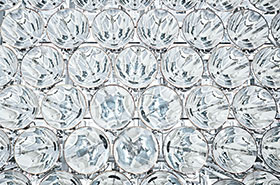
The DLR Institute of Solar Research in Jülich, Germany, recently put the Synlight high-flux solar simulator into operation. This high-power radiator – the only one of its kind in the world so far – consists of 149 radiators, each with the light power of a large cinema projector. Together, they generate light intensity corresponding to at least 10 000 times the intensity of natural solar radiation measurable on the earth’s surface. Three embedded PCs connected with 447 stepper motor terminals from Beckhoff enable highly precise alignment of the individual radiators.
The focus of the Synlight facility is the development of production processes for solar fuels, i.e. fuels that are generated using solar energy. In addition, researchers and industrial partners in the solar thermal power plant or aerospace industries will find ideal conditions for tests of their full-size components. One such application is the efficient production of hydrogen as a CO2-neutral energy source. In order to split water into hydrogen and oxygen, the solar simulator heats metal to a temperature of 800°C. When steam is added, the metal reacts with the oxygen in water and the hydrogen is released. The oxygen is then separated from the metal again by further heating to 1400°C.
High radiation power and precise focus capabilities
Synlight’s novel modular design is unique in its use of 149 individually adjustable xenon short-arc lamps with a light spectrum very similar to the sun. These enable radiation powers of up to 1x300 kW and 2x240 kW in three separately usable radiation chambers. According to Dr Dmitrij Laaber, the control specialist responsible for Synlight at DLR, the artificial sun achieves around 10 times higher power output than conventional laboratory systems.
Two of the three test chambers have been specially designed for solar-chemical process development testing and offer direct access to gas scrubbers and neutralisers, permitting the qualification of processes in the production of solar fuels. The shutter sizes measuring 4 m in width and height, as well as room heights of 5 m, offer the possibility to irradiate large elements, such as spaceflight components. A fundamental feature of Synlight is its multi-focus capability. This allows the light beam to be precisely focussed (even in subsets) and used as required, either for one large application or divided among a number of small test beds.
Compact and system-integrated drive control
The internally mirrored lamp shades used as reflectors have a diameter of 1 m and are mounted in a honeycomb pattern on an area measuring 14 m high and 16 m wide. PC-based control technology from Beckhoff ensures exact alignment and positioning of the individual reflectors to achieve the desired radiation focus. Each radiator is individually controllable, and as a result, highly diverse layouts and temperatures can be created at the target point – even when three tests take place in parallel. The numerous stepper motors required for this purpose are controlled by a total of 447 space-saving KL2541 and KL2531 stepper motor terminals directly integrated into the modular I/O system. These are in turn connected to three CX5130 Embedded PCs via 50 BK9000 Ethernet TCP/IP bus couplers.
The KL2541 stepper motor terminals with incremental encoder are designed for the medium performance range with an output of 50 VDC at 5 A. These devices integrate PWM output stages for a wide range of voltages and currents, as well as two inputs for limit switches in the extremely compact form factor of a 24 mm bus terminal. The KL2531 terminals, measuring only 12 mm wide and rated for 24 VDC at 1,5 A, are suitable for integration with a great variety of small stepper motors.
According to Laaber, the advantages in practical use are immediately apparent, due to the large number of drive controllers: “If we had used conventional stepper motor controllers, the necessary 447 individual devices would have required a huge amount of space. Not only that, we would have had to connect each device with its own network cable, and that would have been enormously complex, intricate and prone to errors. Conversely, the current solution is much more convenient and compact, especially when one considers that the terminals are distributed over five levels in 10 terminal boxes. We have also benefited from TwinCAT software, because a pure automation environment such as TwinCAT is much simpler to program than a solution based on high-level languages, which is what stepper motor manufacturers usually offer.”
For more information contact Michelle Murphy, Beckhoff Automation, +27 (0)11 795 2898, michellem@beckhoff.com, www.beckhoff.co.za
| Tel: | +27 11 795 2898 |
| Email: | info@beckhoff.co.za |
| www: | www.beckhoff.com |
| Articles: | More information and articles about Beckhoff Automation |






© Technews Publishing (Pty) Ltd | All Rights Reserved
 printer friendly version