Surge protection for petrol stations is critical
October 2015
Electrical Power & Protection
Petrol stations are highly vulnerable to lightning strikes and surges due to their extremely sensitive control and display systems. The necessity of a lightning protection system is essential when considering the highly flammable sources of ignition on site. Prudent building regulations dictate that structures where a lightning strike can easily occur or can have serious consequences due to their location, type of construction or use, must be equipped with permanently effective lightning protection systems. Operators of petrol stations need to ensure that employees, customers and pedestrians are protected against fire and explosion risks caused by fuels and vapours.
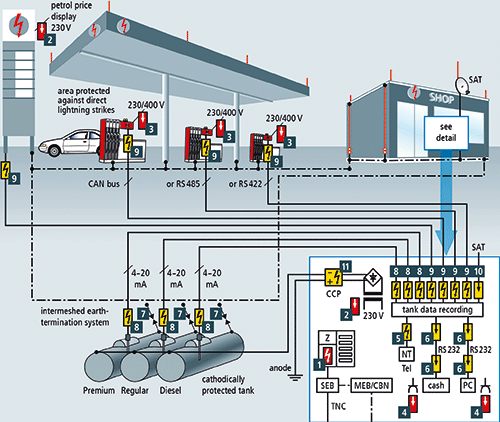
The IEC 60364-1 (HD 60364-1) standard specifies that “property shall be protected against damage as a consequence of over voltages such as those originating from atmospheric events or from switching”. The surge protective devices recommended in this standard must not be installed in Ex zones (zone 0, 1 and 2), if any. If surge protective devices are located in hazardous zones, adequate measures (e.g. approved enclosures and/or approved surge protective devices) must be taken to avoid ignition.
A professional external lightning protection system, consistent lightning equipotential bonding and additional surge protection measures are required to protect petrol stations from direct lightning strikes.
Equipment located in the forecourt, such as the petrol price display, and the incoming utility line are vulnerable to direct lightning strikes. Therefore, lightning current arresters should be installed at the entrance point into the building.
The fuel dispensers are generally located underneath a projecting metal roof and are thus protected against direct lightning strikes. For this reason, and due to the intermeshed earth-termination system, surge arresters are installed at the entrance point of the lines into the petrol station building and at the entrance point of the lines into the fuel dispenser to protect the lines leading to the fuel dispenser electronics.
It is important to interconnect all metal constructions, such as pipes, fuel dispenser enclosures, and tanks, and to connect them to the earth-termination system of the petrol station building. The earth-termination system should have an earth resistance of < 10 Ω (recommendation).
For more information contact Alexis Barwise, Dehn Africa, +27 (0)11 704 1487, alexis.barwise@dehn-africa.com, www.dehn-africa.com
Further reading:
Setting new standards in dry-type transformer technology
Electrical Power & Protection
Dry-type transformer technology is gaining ground globally, and leading the charge in Africa is Trafo Power Solutions, in partnership with Italian manufacturer, TMC Transformers.
Read more...
Advanced process control for the IRP
Schneider Electric South Africa
Electrical Power & Protection
One of the main challenges in implementing South Africa’s Integrated Resource Plan is ensuring grid stability while integrating renewable energy sources and balancing fluctuating energy demands. Advanced process control can play an important role.
Read more...
Revolutionising fault location and maximising solar production
Comtest
Electrical Power & Protection
Comtest has on offer the Fluke GFL-1500 solar ground fault locator, a frontline troubleshooting tool that helps technicians pinpoint active ground faults in solar photovoltaic systems.
Read more...
Supporting the AI boom with power architecture
Electrical Power & Protection
Hitachi Energy is supporting the 800 VDC power architecture announced by Nvidia, by developing a cleaner, more efficient way to power the next generation of AI infrastructure.
Read more...
Kyocera releases new stacked capacitors
Electrical Power & Protection
Kyocera AVX has released the new KGP Series commercial-grade stacked capacitors for high-frequency applications in the industrial and downhole oil and gas industries.
Read more...
More sustainable tyres
Electrical Power & Protection
Continental is prioritising the use of renewable and recycled materials in its tyre production
Read more...
World’s first hydrogen-powered driverless tractor
Electrical Power & Protection
Kubota has unveiled the world’s first hydrogen fuel cell tractor with a self-driving function.
Read more...
ABB drives rail modernisation and EV growth in South Africa
ABB South Africa
Electrical Power & Protection
ABB’s work in Africa in low- and medium-voltage infrastructure, safety-critical components and electrification puts it at the heart of accomplishing the Southern African Railways Association’s strategy.
Read more...
Revolutionising electrical infrastructure through digital innovation
Schneider Electric South Africa
Electrical Power & Protection
In today’s rapidly evolving industrial and commercial landscapes, the integrity of electrical infrastructure has become a non-negotiable priority.
Read more...
Hitachi Energy’s power quality solution
Electrical Power & Protection
Hitachi Energy has announced the deployment of its power quality solution to connect Tanzania’s leading gold producer, Geita Gold Mine (GGML) securely to the national grid.
Read more...










 printer friendly version