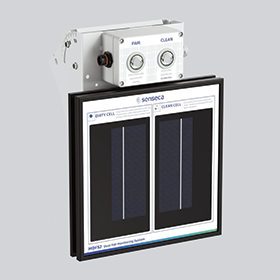
Keeping solar panels clean is the only way to ensure that they function effectively. Dust, dirt and other assorted debris can block the sunlight that solar panels rely on to deliver power. Dirty solar panels can lead to a reduction in performance of up to 25%, as well as potentially causing hot spots that damage cells. To assist in the quick monitoring of solar panels for dirt, Senseca has introduced the Dust Fall Monitoring System (MDFS), which has been designed to alert control centre operators at photovoltaic solar farms and other commercial developments utilising solar panels as to when their panels need to be cleaned.
“The MDFS system is easily added to the solar panel control system and compares the radiation collected by two-compensated reference cells with outputs either in voltage (Model MDFS2) or Modbus protocol (Model MDFS2-S). One cell (clean cell) must always be kept clean, while the other (dirty cell) is cleaned at the same time as the PV panels,” said Jan Grobler, managing director of Senseca South Africa. “The device enables a quick identification of dirty solar panels which ensures that any drop in the performance of the panels is rectified timeously. The device is compact, lightweight and easy to install in existing systems.”
The MDFS can be used in two ways:
• Basic Mode: When manually comparing the clean and dirty cell readings, the operator can decide when cleaning is needed. In this mode, the control box is not required.
• Advanced Mode: With the optional control box, the system automatically calculates the soiling attenuation rate (%) of the PV panels. This value can be used directly to decide if cleaning is necessary, while providing confirmation that cleaning and other maintenance tasks have been performed.
The MDFS system provides five data channels: sun elevation, clean solar cell rad, dirty solar cell rad, MDFS status, and attenuation.
Both the MDFS2 and MDFS2-S offer a measurement range of 0 to 1400 W/m2, operating temperatures of -20 to 60°C and pairing instruction via digital outputs. In addition, the MDFS2 offers a measurement error of ±2,1% and the MDFS2-S offers a ±2,2% measurement error.
The METEODATA-4000 Data Acquisition System (DAS) model collects the solar radiation gathered by the lean reference cell and the dirty reference cell, and any additional information regarding tasks performed in the field sensed by the control box. This is all utilised in the calculation of attenuation due to soiling. The data collected by the DAS is recorded in a SQL server installed in a data collection centre, where it is accessible to be displayed and exported to Excel files.
“The MDFS is a welcome addition to the Senseca product range of environmental monitoring instrumentation, which we believe will assist in ensuring that PV farms and large commercial solar panel installations are running optimally at all times,” concluded Grobler.
Strengthening the backbone of critical infrastructure ACTOM Electrical Machines
Electrical Power & Protection
Many sectors depend on mission-critical facilities to deliver uninterrupted services. Ensuring that these operate without disruption requires equipment that can support changing energy demands, tolerate grid instability and offer strong protection and monitoring capabilities.
Read more...Why expert O&M will secure South Africa’s energy future
Electrical Power & Protection
As more companies depend on embedded generation to stabilise operations and manage electricity costs, day-to-day performance has become one of the most critical factors influencing business continuity. This shift firmly places operations and maintenance at the centre of long-term energy reliability and financial returns.
Read more...Legrand strengthens high-efficiency UPS offering
Electrical Power & Protection
Legrand SA’s next-generation Keor DK single-phase uninterruptible power supply has been designed to deliver high levels of power continuity, efficiency and operational flexibility in technical and infrastructure installations where consistent power quality is essential.
Read more...Real-time modelling is the key to a resilient, bi-directional energy future Schneider Electric South Africa
Electrical Power & Protection
South Africa’s electrical grid is a classic example of a traditional power system, designed for one-way energy flow. This linear model worked well for decades. Today, however, it is being fundamentally disrupted, as South Africa’s ongoing energy crisis has sparked large-scale investment in distributed energy resources.
Read more...Are South African businesses ready for businesses to go off-grid?
Electrical Power & Protection
South Africa’s energy market is changing fast. For many companies, off-grid is no longer just a backup option or a safety net. It is the strategic choice for energy security, sustainability and predictable costs.
Read more...Earth leakage relay Vepac Electronics
Electrical Power & Protection
The ELR01PN from Vepac measures highly sensitive currents of 0,06 mA to 1 A and continuously displays them via an LED bar indicator.
Read more...ABB advances low-carbon, energy-resilient manufacturing
Electrical Power & Protection
ABB is advancing its Mission to Zero programme, demonstrating how onsite renewable energy, electrification and digital energy management can deliver meaningful emissions reductions while strengthening energy resilience.
While every effort has been made to ensure the accuracy of the information contained herein, the publisher and its agents cannot be held responsible for any errors contained, or any loss incurred as a result. Articles published do not necessarily reflect the views of the publishers. The editor reserves the right to alter or cut copy. Articles submitted are deemed to have been cleared for publication. Advertisements and company contact details are published as provided by the advertiser. Technews Publishing (Pty) Ltd cannot be held responsible for the accuracy or veracity of supplied material.










 printer friendly version