



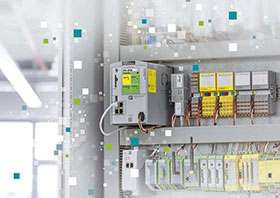
The RFC 4072S Remote Field Controller is the highest performance device in the Phoenix Contact controller portfolio. The PLC is ideal for use as a central controller, in particular in computation-intensive applications with the highest safety-related requirement levels SIL 3 and PL e. It also features time-deterministic processing of IEC 61131 and high-level language programs as well as Matlab Simulink models.
From a technical perspective, the RFC 4072S is a combination of an operational and safety-related controller. The operational controller processes the standard application and is responsible for data transmission with the standard I/Os via the Profinet protocol. The safety PLC runs the safety-related program and communicates via F-host instance. This makes it possible to operate up to 300 subordinate F devices in the PROFIsafe network. The RFC 4072S supports the latest PROFIsafe profile V 2.6.1, which means it can be used to control the latest ‘F’ devices.
Combined use of different programming languages
With PLCnext Technology, Phoenix Contact provides an open ecosystem for current and future automation requirements that allows for the convergence of automation tasks and IoT demands. In addition to the PLCnext controller, the ecosystem comprises the modular software platform PLCnext Engineer, the digital marketplace PLCnext Store, the PLCnext Community, and the option for systemic cloud integration. The specially developed firmware architecture allows the user to use IEC61131 programming languages in combination with high-level languages, such as C++ or C#, or a control algorithm model in Matlab Simulink. A control program can consist of just one or any combination of the languages specified above.
When processing high-level language programs in industrial control systems, the challenge lies in the fact that the code does not have a force-guided cycle. As a solution, PLCnext technology offers a middleware between the operating system and the user level. This approach involves the scheduler, which is referred to as the execution and synchronisation manager (ESM). The ESM ensures that, for example, programs written in C++ or C# can be executed in models generated by Matlab Simulink as well as applications created in accordance with IEC 61131-3 in a defined and time-deterministic sequence. On the other hand, a smart shared memory – Global Data Space (GDS) – ensures a cycle-consistent data transfer between the various programs and the I/O level.
As a further component of the ecosystem, the PLCnext Store offers finished, pre-programmed software applications (apps) that can be run directly on the RFC 4072S. The different apps are not only offered by Phoenix Contact, but also by third-party providers.
Shorter program runtime
The PLCnext technology functions as the firmware of the operational controller of the RFC 4072S. The firmware architecture makes it possible for code on the Intel i5 dual-core processor that was created using different programming languages to be freely assigned to core 1 or core 2. Compared to a single-core system, this unbundling offers the following advantages for the user application created in IEC 61131-3, high-level language or Matlab Simulink: shorter program runtimes and reduced variance compared to the average runtime. This is because, for example, programs with different priorities and longer processing times are not interrupted when they are executed on different cores.
If the use of safety-related components is required, the RFC 4072S can, for example, be used to control a wind turbine. One specific field of application is adjusting the wind turbine rotor blades. As part of this pitch control system, the current rotor blade position can be detected and, for example, transmitted to an RFC 4072S. The set-point of the rotor blade position is calculated based, among other things, on the failsafe detection of the prevailing wind speed via an anemometer, which is then processed in the safety program of the remote field controller. If the wind speed exceeds a critical value in a short period of time, for example due to a gust of wind, the safety-related controller sends the signal to turn the rotor blades out of the wind. However, if the measured wind speed is in the permitted range, the data is evaluated in the operational controller.
Further processing of recorded data
The operational control PLC uses the current value of the wind speed in a program in accordance with IEC 61131-3 and visualises it as a percentage of the permitted nominal value for diagnostic purposes. Next, the value is processed in a Matlab Simulink model. The user receives the orientation of the nacelle and the position of the rotor blade for optimal energy generation as set-point values. In order to determine the absolute target position of the rotor blade, a program created using C++ converts the absolute values to a control signal for the positioning motor. The converted value is then compared to the current actual value and, if the two values are not identical, the new set-point is communicated to the positioning motors via a fieldbus system.
The wind speed can be sent to the Proficloud for statistical purposes. Here, the data can be stored in a log, processed, and visualised as a sequence of time. Because the wind turbines can be installed in different regions, the wind speed as well as the resulting energy generated can be merged centrally in Proficloud. Recording values is simple: When a program is set up, the user only needs to add an additional check mark for the RFC 4072S in order to transmit the variable to Proficloud.
| Tel: | +27 11 801 8200 |
| Email: | sbritz@phoenixcontact.co.za |
| www: | www.phoenixcontact.co.za |
| Articles: | More information and articles about Phoenix Contact |






© Technews Publishing (Pty) Ltd | All Rights Reserved
 printer friendly version