



Siemens reduces programming effort and shortens cycle times with ShopMill and ShopTurn software.
Kottmaier CNC Drehund Frästechnik, headquartered in southern Germany, specialises in machining stainless steels and high-alloy tool steels. To enable it to carry out the time-critical process of producing sample and prototypes in line with customer requirements, the company has installed ShopMill, or ShopTurn respectively, on all of its CNC machines. The advantage of this arrangement is that workers can use several programming stations simultaneously, without the need for additional hardware solutions and office space.
Both solutions accurately reflect the operator’s view of the work pieces and work processes by enabling an intuitive approach to programming and providing swift access to the CNC functions on the machines. Employees can therefore create parts programs themselves after just a short induction period.
Programming in graphical or ISO mode
Although 3+2-axis machining of complex, non-prismatic parts makes up a high percentage of the order volume, the manufacturing company does not require especially trained CAD specialists and programmers. Company owner Helmut Kottmaier attributes this largely to the software’s user-friendly user interface: “Graphical parts programs can be created quickly. Even for thread repairs, the programming of the thread cycles takes just a few seconds. It used to take at least several minutes.”
Most of the employees now use graphic-aided program creation. For those who prefer the traditional ISO programming process, this option is available at any time in ShopMill and ShopTurn. The ISO code can be combined freely with the cycles used by the shop floor software. It is possible to switch from the graphical interface to the ISO view at any stage of the work process. This allows staff to continue using their CNC expertise. The operating concept of both software modules is also the same for both turning and milling. Staff can be dispatched flexibly for operation of both the turning and milling machines used in production.
No more manual retooling of work pieces
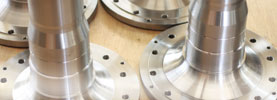
Besides companies from the automotive industry, one key customer of the metal processing company is the robot manufacturer Kuka, whose order specific prototypes and sample parts often include complicated gearbox covers or flanges. To ensure that development and production of the prototypes and pre-production models makes steady progress, Kuka needs the parts as quickly as possible. “With the contour path editors in the shop floor software, we can create the design quickly from the drawing and manufacture it directly,” explains Kottmaier.
The two turning machines from Spinner, recently procured, have also been equipped with ShopTurn as a user interface. A Sinumerik 840D is used as the control system. As there is no perceptible difference between the user interfaces and controls on the new machines and those on the machines used to date, staff were able to get to grips with the new machines straight away.
ShopMill and ShopTurn help not only with the production of individual parts and small volumes, but also in serial production of parts that are in frequent demand. Thanks to the software, the strengths of the individual technologies and machines can be utilised to optimise series production. Through clever use of the software, a part that was previously manufactured on the milling machine from parts cut in five mounting processes can now be produced on the CNC turning machine without the need for manual retooling. Labour time is minimised, which is particularly important for serial parts where the profit margin is often just a few cents.
Significant increase in overall output by combined use of machines
With complicated turned parts that require the use of many tools, the combined use of a turning and milling machine is often a faster alternative, according to Kottmaier. “Producing a gearbox cover often requires the use of 32 different tools. This exceeds the capacity of the tool changer on many turning machines. Milling machines can hold considerably more tools.
“Instead of manufacturing a part completely on the turning machine and continually swapping the required tools manually, it is quicker to switch to the CNC milling machine for milling, drilling and thread cutting. Despite retooling, the parts are ready in a shorter amount of time and the overall throughput rate of the turning machine is considerably better. Precise retooling is also simpler and faster thanks to the shop floor software’s setup function.”
For more information contact Keshin Govender, Siemens Southern Africa, +27 (0)11 652 2412, [email protected], www.siemens.co.za
| Tel: | +27 11 652 2000 |
| Email: | [email protected] |
| www: | www.siemens.co.za |
| Articles: | More information and articles about Siemens South Africa |






© Technews Publishing (Pty) Ltd | All Rights Reserved
 printer friendly version