



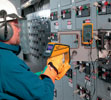
Thermal imaging can be used to evaluate the operating condition of the components within motor control centres (MCCs) by comparing the relative temperatures of components under load.
Thermal imagers can indicate the operating condition of the components within MCCs by comparing their relative temperatures under load.
Key components to be monitored include bus bars, controllers, starters, contactors, relays, fuses, breakers, disconnects, feeders and transformers.
Caution
Only authorised and qualified personnel using the appropriate personal protective equipment should open electrical panel covers. When a panel is open and energised, because of the possibility of arc-flash, all unprotected personnel should be kept behind a calculated and clearly delineated arc-flash boundary.
What to check?
* To keep the task manageable, begin by scanning only MCCs associated with critical assets - those whose failure would threaten people, property or product.
* Scan all components and connections within MCCs with the enclosures open and the equipment running.
* Measure the load at the time of each scan to properly evaluate the measurements against normal operating conditions.
What to look for?
* Look for components that are hotter than similar components under similar loads.
* Look for components that are cooler than similar components under similar loads.
* Doing this may identify broken or undersized wires, defective insulation, faulty (corroded, too loose or over tightened) connections and electrical unbalance among phases.
* Connection related hot spots usually (but not always) appear warmest at the spot of high resistance, cooling with distance from that spot. One source1, reports that 25% of all miscellaneous electrical apparatus failures are caused by loose electrical connections.
* Unbalance, whether normal or out of specification, will appear equally warm throughout the phase or part of the circuit that is overloaded. Harmonic unbalance creates a similar pattern.
* A cooler-than-normal circuit or leg might signal a failed component.
* All electrical currents produce some heat. Heat alone, then, is not an indicator of problems. Equally warm conductors in all three phases represent a 'good' pattern. Differentiation between phases should be investigated.
Record keeping
* Create regular inspection routes that include all key electrical panels, including MCCs.
* Save a thermal image and associated temperature data of each one on computer and track measurements over time.
* This will provide a baseline for comparisons in order to determine whether a hot spot is unusual or not, and to help verify a repair's success.
What represents a red alert?
* Equipment conditions that pose a safety risk should receive the highest repair priority.
* Guidelines provided by the NETA (InterNational Electrical Testing Association) say that when the difference in temperature (DT) between similar components under similar loading exceeds 15°C immediate repairs should be undertaken.
* The same organisation recommends the same action when the DT for a component and ambient air exceeds 40°C.
* Another approach is to treat the imminent failure of any piece of critical equipment as a red alert.
* The same key operations, maintenance and safety personnel who determine which production assets are critical should play important roles in quantifying 'warning' and 'alarm' levels for those assets.
* Set alarm levels for specific equipment on your thermal imager.
The potential cost of failure
* Since MCCs vary so much in complexity, it is difficult to put firm figures on costs for repairs and replacements. However, one European source2 says that the average MCC repair is between 10 000 Euros (R90 000) and 70 000 Euros (R630 000) with replacements costing 80 000 Euros (R720 000) to 100 000 Euros (R900 000).
Follow-up actions
* When a problem is discovered using a thermal imager, use the associated software to document the findings in a report that includes both a digital photograph and a corresponding thermal image of the equipment.
* Following corrective action, use a new thermal image to assess a repair's effectiveness and evaluate the materials and techniques used.
Sources:
1: The website of the Academy of Infrared Thermography at www.infraredelectrical.com/ infraredelectrical_15.html.
2: Ibid.
The information for this Tech Tip was provided by Comtest Distribution.
For more information contact Val Verwer, Comtest Distribution, +27 (0)11 254 2200, [email protected], www.comtest.co.za
| Tel: | +27 10 595 1824 |
| Email: | [email protected] |
| www: | www.comtest.co.za |
| Articles: | More information and articles about Comtest |






© Technews Publishing (Pty) Ltd | All Rights Reserved
 printer friendly version